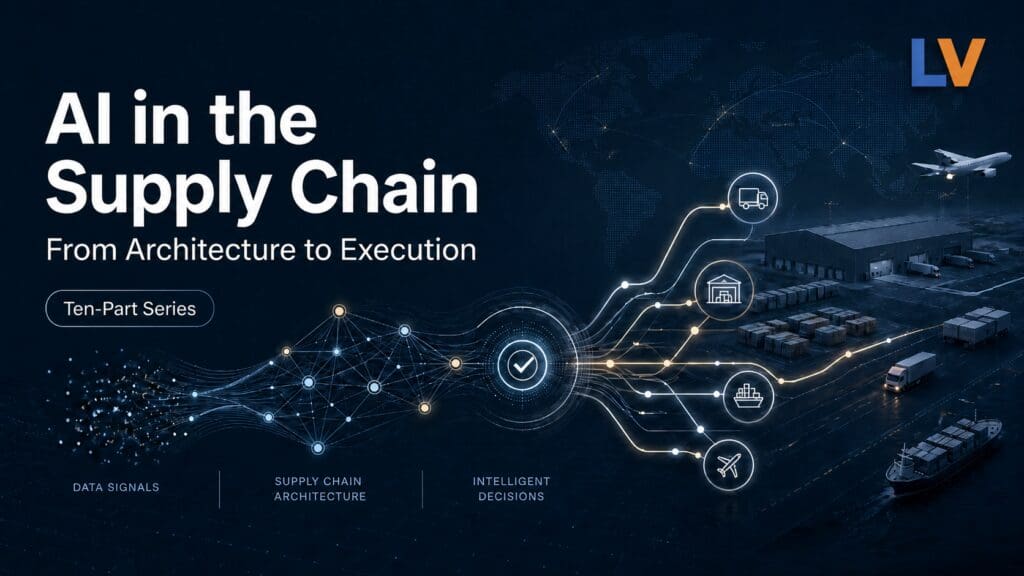
The next phase of supply chain AI will not be defined by better models alone. It will be defined by whether those models can improve real decisions across planning, logistics, sourcing, fulfillment, and risk management.
Artificial intelligence has moved quickly through the supply chain conversation.
The first wave focused on what AI could do. Could it improve forecasts? Detect disruptions? Summarize documents? Support planners, buyers, dispatchers, and customer service teams?
Those were useful questions. They helped establish the architectural foundation for AI-enabled supply chains: agent-to-agent communication, retrieval-augmented generation, graph-based reasoning, persistent context, and more interoperable data environments.
But architecture is not execution.
The harder question now is whether AI can improve real operating decisions inside complex supply chains. These are decisions involving cost, service, inventory, capacity, risk, customer commitments, physical assets, and financial consequences.
A model may forecast demand. A visibility platform may detect a disruption. An agent may recommend a response. None of that matters much unless the organization can turn the signal into coordinated action.
That is the focus of this new Logistics Viewpoints series.
From AI Capability to Operational Decision-Making
The first phase of supply chain AI was about capability. The next phase is about consequence.
Supply chains are not abstract information systems. They are physical operating networks. A transportation decision changes cost and service. An inventory decision affects availability and working capital. A sourcing decision changes risk exposure. A warehouse decision changes labor, throughput, and customer performance.
This is where many AI programs stall.
They produce insight, but the workflow does not change. They generate recommendations, but decision ownership remains unclear. They detect exceptions, but the organization still responds through manual handoffs, email chains, spreadsheets, and delayed escalation.
The result is decision latency: the gap between when a condition changes and when the organization executes a coordinated response.
In volatile supply chain environments, decision latency is not just an inconvenience. It becomes a structural weakness.
Why the Decision Intelligence Layer Matters
Enterprise supply chain technology has long been organized around systems of record and systems of planning.
ERP, WMS, TMS, order management, procurement, and planning platforms remain essential. They preserve transactions, manage workflows, and support structured planning processes.
AI introduces the need for another layer: a decision intelligence layer.
This layer does not replace existing systems. It operates across them. It connects signals, context, reasoning, governance, and execution. It helps the enterprise evaluate conditions continuously, understand tradeoffs, and support or initiate action within defined boundaries.
That distinction matters.
Not every AI system should be allowed to operate near physical or financial consequence. The closer AI gets to execution, the greater the need for context, determinism, governance, auditability, and human oversight.
Supply chain AI is not one category. It is a set of capabilities that must be matched to the decision environment in which they operate.
What the Series Will Cover
This ten-part series examines how supply chain AI moves from technical architecture to operational execution.
The series will cover:
1. From Capability to Execution
Why the supply chain AI conversation is moving beyond pilots, demonstrations, and technical capability toward measurable operational impact.
2. The Decision Bottleneck
How fragmented systems, functional handoffs, and delayed escalation create decision latency across modern supply chains.
3. From Systems of Record to Systems of Decision
Why AI adds a new decision layer above ERP, planning, TMS, WMS, and visibility platforms.
4. Operational AI Requires Action Pathways
Why AI insight has limited value unless it connects to workflows, owners, thresholds, execution systems, and feedback loops.
5. Five Requirements for Operational AI
The operating requirements that separate useful AI from AI theater: decision-ready data, contextual intelligence, action pathways, governance, and closed-loop learning.
6. From Agent Communication to Coordinated Execution
Why agentic AI matters only if it improves cross-functional coordination, not simply because agents can communicate.
7. Context Becomes a Requirement
Why supply chain AI must understand history, supplier performance, customer commitments, contracts, network dependencies, and prior exceptions.
8. Planning and Execution Are Converging
How AI changes the cadence of supply chain management by embedding planning logic inside execution workflows.
9. Market Structure: From Functional Software to Decision Architectures
Why buyers should increasingly evaluate technology providers by the decisions they improve, not only by the software category they occupy.
10. Operating Model Implications
How decision-centric AI changes roles, metrics, governance, accountability, and the future work of supply chain planners and operators.
The Buyer Question Is Changing
For years, supply chain technology evaluation has often started with functional categories.
What does the system do? Is it a planning platform, TMS, WMS, visibility solution, risk platform, procurement tool, or analytics application?
That question still matters. But it is no longer sufficient.
The more important question is becoming: what decisions does this system improve?
Does it improve replenishment decisions? Transportation decisions? Supplier risk decisions? Inventory allocation decisions? Customer commitment decisions? Exception resolution decisions?
And just as important: how does the recommendation connect to execution?
This is where the market is moving. Planning vendors, execution platforms, visibility providers, risk intelligence solutions, and enterprise software companies are all embedding AI more deeply into their offerings. Their starting points differ, but the direction is consistent.
The market is shifting from functional software toward decision-centric architectures.
That shift will create opportunity, confusion, and new evaluation challenges for buyers.
Why This Matters Now
Supply chain leaders are not short on AI claims.
They are short on proof.
They need to know where AI can improve real decisions, where it should remain advisory, where autonomy is inappropriate, and where governance needs to be built before scale.
They also need a practical way to separate serious operational AI from generic AI positioning.
That requires a more disciplined conversation. Not just about models. Not just about agents. Not just about data. But about decision environments, operating consequences, and the architecture required to move from insight to action.
Closing CTA
Logistics Viewpoints and ARC Advisory Group are examining how decision intelligence, agentic AI, contextual reasoning, and next-generation supply chain architectures are reshaping supply chain technology markets.
Follow this ten-part series on Logistics Viewpoints as we examine how supply chain AI is moving from architecture to execution.
We will listen to your situation, offer a candid outside perspective, and, where appropriate, suggest practical next steps or areas where ARC research and advisory support may help.
The post AI in the Supply Chain: From Architecture to Execution appeared first on Logistics Viewpoints.