Before the mezcal bars, jungle tasting menus, and all-night beach parties, Tulum’s drinking culture revolved around simple things: ice-cold beers, fresh lime, Coca-Cola, and whatever else could survive the Caribbean heat. Even now, caguamas — oversized bottles of Mexican lagers meant for sharing — still appear on tables long before sunset, sweating through buckets of ice while the humidity settles in for the night.
That simplicity continues to define the way Tulum drinks today. For all the town’s global attention, dramatic hotel design, and highly stylized nightlife, its drinking culture remains surprisingly climate-driven. And that’s why Tulum continues to drink differently from other destinations in Mexico.
“The Margarita is always present,” says Carlos “Berry” Mora of ARCA, who was recently named Mexico’s Bartender of the Year by the Guía México Gastronómico 2026. “It comes in and out of focus, but it never disappears.” And while the Margarita may be Mexico’s most recognizable cocktail, in Tulum it eventually became the Mezcalita, a Margarita built with mezcal instead of tequila. Smokier, earthier, and slightly wilder, mezcal fits naturally into the town’s atmosphere.
“Tulum is very much a mezcal and Margarita town,” says Jaime Huerta Uribe, director of food and beverage at Nômade Tulum. “There’s a strong appreciation for fresh fruit, herbs, local ingredients, and cocktails that feel lighter and more refreshing.”
Across beach clubs, mezcalerías, roadside juice spots, natural wine bars, and late-night dinner parties, Tulum has built one of the most distinctive drinking cultures in Mexico. Cocktails lean citrus-heavy, tropical, mineral, and easy to keep ordering. Mezcal is sharpened with fresh lime and fruit. Spritzes stretch through late afternoons, coconut water becomes part of the hangover ecosystem, and even the town’s more ambitious cocktail bars prioritize freshness and drinkability over theatrics.
Credit: ARCA Bar
Tulum’s First Cocktail
The first real shift toward a recognizable “Tulum cocktail culture” arguably came from Batey, the now-iconic local bar known for its sugar cane Mojitos. Fresh sugar cane pressed directly into the drink, seasonal fruit, lime, and crushed ice created something looser, messier, and far more tropical than the classic Cuban version. In many ways, it became one of Tulum’s first signature cocktails, built specifically for the climate itself.
“Tulum drinks with intention,” says Pablo De La Torre, food and beverage and operations director at GITANO, the town’s iconic dinner and dance party destination. “People aren’t just ordering a cocktail, they’re looking for a connection to place.” Over time, the town’s drinking culture evolved alongside its nightlife. Beach bars became jungle parties, dinners stretched later into the night, and cocktails became more central to the experience.
Still, Tulum never fully abandoned its relaxed approach to drinking. Even at the height of its nightlife era, there remained something unfussy about the way people drank there.
Credit: GITANO Tulum
How Mezcal Became the Spirit of Tulum
Long before mezcal became globally fashionable, bottles were already circulating along the Beach Road, often brought directly from Oaxaca by travelers, chefs, and party crowds. Elliott Bennett Coon, co-founder of Gem & Bolt mezcal, shared that in the early days, people were literally driving mezcal into town themselves.
Today, mezcal remains the backbone of the area’s drinking culture, though the way people drink it has evolved. Earlier versions of Tulum nightlife featured heavier pours and intensely smoky cocktails. Now, bartenders are moving toward fresher, brighter, and more balanced creations designed for the climate itself.
“Tulum is very much a mezcal and Margarita town. There’s a strong appreciation for fresh fruit, herbs, local ingredients, and cocktails that feel lighter and more refreshing.”
If there is one cocktail that represents modern Tulum, it is GITANO’s “Jungle Fever.” Built around mezcal, pineapple, lime, chile, and cilantro, the drink has become one of the defining cocktails of the Beach Road. Smoky, spicy, herbal, and tropical all at once, it captures the essence of the style of drinking that has come to define Tulum over the last decade. “The jungle, the cenotes, the Mayan heritage, all of it shows up in the glass,” says De La Torre.
At the same time, the town’s relationship with mezcal has become more sophisticated. At AZULIK, the hotel developed its own in-house mezcal made in Oaxaca and built Mantli, a dedicated mezcalería centered around tastings, education, and agave culture. “Mezcal remains the root,” says Jesus Ochoa, food and beverage manager at AZULIK. “But the scene has evolved into something broader and more complex.”
That greater agave conversation now includes sotol, raicilla, bacanora, and even Mexican gin (particularly Gracias a Dios agave gin). These varieties have become prominent, appearing across menus as drinkers become more familiar with mezcal itself. “Mezcal opened the door,” says De La Torre. “Now people want to explore the whole house.”
Credit: Negro Huitlacoxe
Fruit Comes First
Tulum’s cocktail culture may revolve around agave, but its defining ingredients are the local fruits — green sour orange, coconut, Yucatán lime, hibiscus, pineapple, tamarind, and passion fruit. Juices that taste like they were pressed minutes earlier (because they were) shape drinks all over town.
“Tulum has a distinctly beach-driven identity, but what many places here really champion is fruit,” says Berry. “The cocktail culture is still ‘wild’ in the best sense, built around fresh fruit pulps, endemic ingredients, and drinks that feel tropical and grounded in place.”
“In many cities, cocktails have become overly standardized, clarified, carbonated, often lacking texture,” Berry continues. “Here, the goal is different: to refine without losing the rawness.”
In Tulum, texture matters. Drinks are intentionally pulpy, herbaceous, spicy, salty, or slightly uneven in a way that feels alive rather than polished away.
At ARCA, that translates into cocktails built with hoja santa, pixtle, sour orange, coconut, and local herbs, many of the same ingredients that define the region’s cuisine thanks to their inclusion in dishes like cochinita pibil and pok chuc. At AZULIK, bartenders work with melipona honey, house ferments, lemongrass, hibiscus, basil, chile, and tropical citrus to create drinks that reflect the region.
Credit: Nomade Tulum
The Popularity of Italian Aperitivos in Tulum
By late afternoon, Tulum increasingly feels like an Italian summer vacation. Spritzes, Negronis, and aperitivo culture have quietly become part of the town’s identity. Long before Tulum became a global wellness and nightlife destination, Italians were among the first international nomads to settle there, helping shape much of the town’s early restaurant culture. Even now, some of Tulum’s most beloved spots remain tied to that influence, from casual pizza places to aperitivo-heavy restaurants and bars.
“There’s a strong Italian influence in Tulum,” says Berry. “That brings the spritz, aperitivo culture, and all the cocktails that come with it.”
At places like El Bodegón and Vaivén, Negronis and spritzes are even more popular than Margaritas. Across menus, bitter aperitifs mix with tropical fruit, sparkling wine, mineral water, herbs, and citrus in ways that feel perfectly suited to the Caribbean heat. La Pizzine, a longtime local-favorite pizza spot, even launched its own house vermouth, Musa Vermut, bottled in beer-shaped glass stamped with the restaurant’s logo.
“Tulum drinks with intention. People aren’t just ordering a cocktail, they’re looking for a connection to place.”
The shift also reflects a broader change in how people drink in Tulum. After long afternoons in the sun, many are gravitating toward lower-ABV cocktails that can stretch across an entire evening. At Nômade, one of the most ordered drinks is the Nômade Spritz, made with St-Germain, basil, lemongrass syrup, mineral water, and Chandon Brut. Aromatic, herbal, and sharply refreshing, it captures the vibe many bars in town are moving toward.
Despite Tulum’s reputation for marathon nightlife, the pace of drinking here has become noticeably slower: long lunches, sunset cocktails, late dinners, and one more spritz before the heat finally breaks.
Credit: Nomade Tulum
Drinking to Your Health
Tulum is also a town built around non-alcoholic drinking. Smoothie spots, juice counters, coconut carts, adaptogenic elixirs, and iced herbal drinks are as much a part of the town’s rhythm as cocktails themselves. In some crowds, an electrolyte paleta from LECTROICE during a party is just as common as a drink.
As Tulum’s wellness identity has expanded, many travelers have started drinking less alcohol or simply pacing themselves differently, alternating cocktails with mineral water, green juice, iced matcha, or coconut water straight from the shell.
At AZULIK, non-alcoholic elixirs are treated with the same seriousness as cocktails. Built with adaptogens, botanicals, ferments, and infusions, they are designed less as substitutes and more as their own category entirely. “The experience doesn’t rely on alcohol to create connection or depth,” says Ochoa.
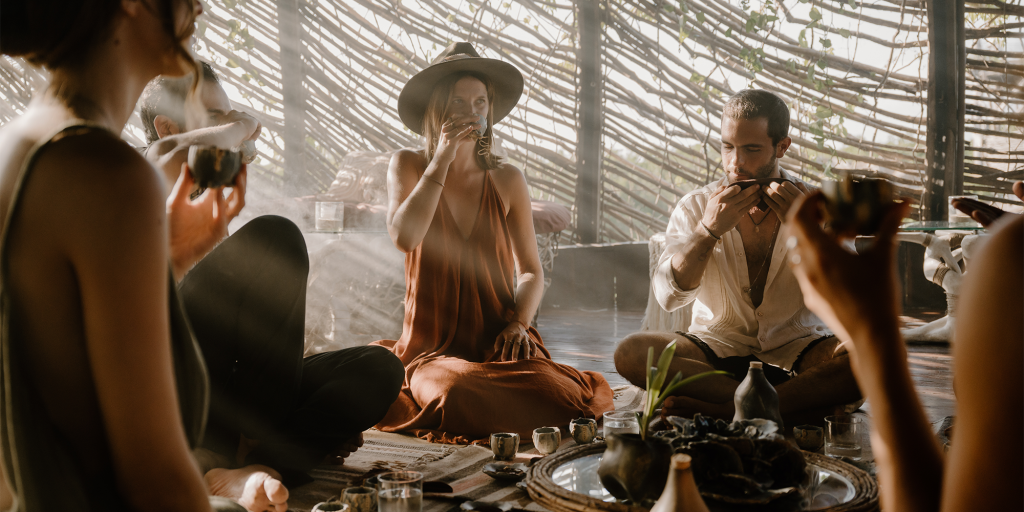
Cacao also plays a major role in Tulum’s drinking culture, appearing everywhere from morning drinks to ceremonies at places like Otti Cacao Bar, Holistika, and IKAL. It is consumed for its energizing, mood-boosting, and so-called “heart-opening” effects, a ritual rooted in both ancient Mesoamerican traditions and the town’s modern spiritual scene. Café culture has expanded as well, with the matcha counter at Tulum-founded Matcha Mama, specialty coffee, juice cleanses, and iced drinks all increasingly commonplace.
Credit: Nomade Tulum
Drinking Like It’s Always Summer
Mexico’s notoriously difficult import and distribution laws mean that even as natural wine bars, spritzes, and international spirits continue arriving in Tulum, the scene still can’t fully drift into the kind of hyper-globalized drinking culture found in cities like New York or London. And that’s a good thing.
Because despite all the evolution, Tulum’s drinking culture remains focused on the basics: cold drinks, fresh ingredients, tropical fruit, citrus, coconut water, and whatever feels best in the heat. The town’s bars may draw international talent and host events like AZULIK’s monthly Sunset Spirits, where globally recognized bartenders gather high above the jungle canopy, but the logic behind the drinks rarely changes.
By sunset, tables fill with condensation-covered cocktails, sweating through the humidity as the air finally begins to cool. At AZULIK, guests sip cocktails suspended in woven nests crafted by local artisans, overlooking the jungle as electronic music drifts through the trees and the sky turns deep orange over the coast. In a place that already feels slightly detached from reality, it’s hard not to let paradise shape the way you drink. And no one really knows what Tulum’s drinking culture will look like in another decade, but it will probably still taste best cold, citrus-heavy, and sipped slowly.
The article When It Gets Hot Outside, Drink Like They Do in Tulum appeared first on VinePair.