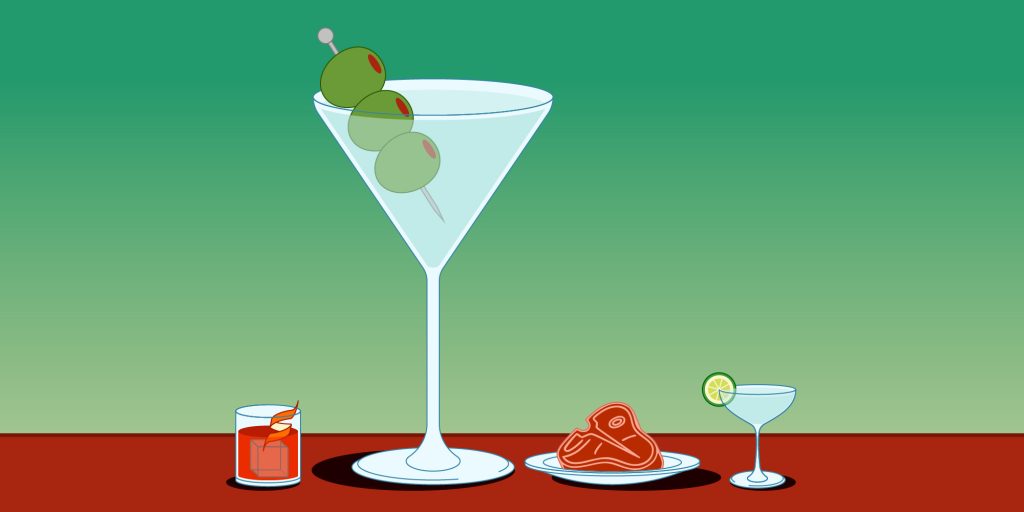
A few weeks ago, a friend and I stopped by an old neighborhood steakhouse for after-work Martinis. Settling into one of their bucket bar seats for a tipple sounded like a good idea, partially because the venue opened in 1967 and stayed there while time and the world moved on. They embrace the time warp: Stepping out of the elevator required to access its subterranean dining space immerses you in a smothering, dimly lit cloak of crimson red seats and maroon carpeting juxtaposed with square pops of white linen tablecloths. The cigarette smoke is implied. Aesthetically speaking, it’s a rather groovy joint.
When the bartender comes around, I keep my Martini order simple: gin, 3-to-1, served in a chilled glass, with an olive. No request for orange bitters. Nothing advanced or nerdy like ordering it “burnt” with a splash of Laphroaig like my wife does. I’m not expecting anything mind-blowing, just a reasonable take on a classic. A few minutes later, the bartender returns with my order. Problem is, it’s not my order — at least, the kind of order I hoped to have. It’s a Martini, but it’s also a cliche: 10 ounces of cold gin served in a semi-chilled glass, with no vermouth to be found.
“Did you add the vermouth?” my friend pipes up, possibly sensing a disturbance in The Force.
“Oh yeah,” the bartender replies. “I grabbed the bottle and waved it over the top of the glass.” He chuckles. I don’t. I’m enjoying spending time with my friend, so I’m not going to make a scene or ask for a re-do or berate the bartender for completely ignoring my order. I gulp down the goblet of gin before the rapidly warming liquid becomes too tepid for consumption. I still have fun, but my inner drinker is seething as I play it safe and switch to a beer.
I also realize I participated in a longstanding drinking tradition. The oversized Martini, where the bartender shoehorns roughly three proper Martini servings in a honking V-shaped glass and skips the vermouth like Winston Churchill used to do, has been a notable part of steakhouse culture, especially among places that have been around for decades. But it’s 2026, not 1966. Consumers are smarter and the vermouth on the market these days is damn good. Should the oversized steakhouse Martini continue to be a part of drinking culture today, or has the behemoth run its course?
Why the Oversized Steakhouse Martini Is Still a Thing
The Martini can often be more than a cocktail. It’s a symbol, and there are several subcategories of symbolism to consider. It’s part of a lifestyle. It’s a sign of class and elegance. It signals maturity.
In the steakhouse world, a jumbo Martini sans vermouth is viewed by some as a liquid symbol for a tradition of excess.
“Going to a steakhouse is an over-indulgent moment,” says Ray Tremblay, director of bars for COJE Management Group, a Boston-based restaurant group whose portfolio includes the recently opened steakhouse Zebra Room. “It’s the one place on Earth where people order a wedge salad, a big steak, and a bowl of creamed spinach. In an old-school steakhouse, the expectation should be a Martini in a comical glass instead of a coupe.”
An oversized steakhouse Martini can also be an unspoken reference to perceived expectations. This may be particularly true in older venues, and not just because they may rock an aesthetic evocative of a time when the Rat Pack rolled through Vegas with Martinis in hand. A steakhouse operating for several decades likely has customers who have patronized it for just as long, and old consumer habits die hard. “For an institutional steakhouse, I think the oversized Martini may be the default option largely because of their clientele and what they have come to expect,” explains Ben Lieppman, beverage director for RPM Steak in Chicago. “If a patron who has been frequenting your bar for 15-plus years comes by, and suddenly their Martini is 50 percent smaller for the same price they’ve paid, they are going to notice.”
Tradition vs. Sensibility
Looking at an oversized Martini as part of a greater steakhouse ritual may be a fair play. This also partially shields the drink from being looked at critically. But should tradition be enough to give the drink a pass?
Remove the drink from the environment and the answer is a clear no. We don’t even need to bring the lack of vermouth into the equation to reach this conclusion. First off, size matters. A proper Martini size is around 3 ounces. A bartender pouring out 10 ounces of spirit is really serving a guest a trio of cocktails. This may be traditional, but it may not be responsible, particularly if the bartender’s not sharing the math with the guest who’s ready to order a second one.
Then there’s the temperature aspect. Martinis are best served cold from the first sip to the last. There are several tactics bars can deploy to maintain constant coldness, from the sidecar to the mid-Martini glass swap. These are much easier to pull off when the Martini is at a sensible 3-ounce pour. It’s almost impossible to do with a Martini reaching double digits in volume. This creates problems no level of tradition can solve.
“If you serve a 10-ounce Martini to someone, that drink is going to get really warm, really fast,” explains Mariena Mercer Boarini, Las Vegas-based master mixologist for Wynn Resorts North America. “By the end of the drink, it’s going to taste offensive.”
This may not have mattered much back in the day. It might matter a whole lot more now. This is certainly reflective in newer steakhouses, where the customers tend to be a little more knowledgeable about what they want compared to older guests who have patronized the same place for decades. Mercer Boarini has witnessed this firsthand at Wynn’s recently opened New York steakhouse transplant, Sartiano’s Italian Steakhouse.
“Going to a steakhouse is an over-indulgent moment. It’s the one place on Earth where people order a wedge salad, a big steak, and a bowl of creamed spinach. In an old-school steakhouse, the expectation should be a Martini in a comical glass instead of a coupe.”
“We’ve found our guests care deeply about their Martinis, and they have high expectations to match,” she says. “They are mindful about everything — the temperature it’s served at, the rate of dilution, even the type of blue cheese we’re using in our blue cheese-stuffed olives.”
As the resurgent interest in Martinis continues to grow, these types of guests present newer steakhouses with the unique chance to steer the conversation toward a more contemporary light, whether this involves focusing on elegant touches like tableside service or leaning into modern trends like savory ingredients to make dirty Martinis filthy. The rationale behind these discussions depends on the steakhouse.
“People are more mindful about what they drink and how much they’re drinking, so I’m more mindful of how and what we’re serving,” Mercer Boarini says. “It’s why in this day and age, serving a Martini that’s 10 ounces or more feels irresponsible to me.”
“I don’t think we need to change the steakhouse Martini game,” says Tremblay. “But, we do need to take advantage of every chance we have to elevate the Martini experience. This means using our tableside service to talk to our guests about the drink.”
Blending the Old and Modern
Brooklyn’s legendary Peter Luger Steakhouse has been in business since 1887, before the Martini was even invented. They’re as old-school as old-school gets, and their nearly 140 years of existence gives them more than enough chutzpah to write the rules of steakhouse Martini engagement, or at least be a solid co-author. They could unequivocally serve their guests a double-digit-ounce, vermouth-free gin Martini as the default “this is the way we do it” option.
They don’t do this. Their default Martinis are on the smaller side. They’ll also listen to their guests and honor their specs as best as they can. They’ll make a giant oversized Martini if the guest desires, but it’s not something they push. It may feel slightly out of step with the expected, perceived ritual of steakhouse Martini excess, but it sure as hell enhances the experience.
“Tradition should be a customer highlight, not a drawback,” explains Daniel Turtel, vice president of Peter Luger. “An old-school steakhouse might have a viewpoint on what the best spec is for the customer’s order, but a Martini is ultimately up to the person who’s going to drink it.”
This customer-focused Martini mindset may slowly be nudging toward more widespread status among the old guard. According to Turtel, the stereotypical old-school steakhouse Martini experience isn’t as prominent as it once was, although there is a catch.
“Any good steakhouse now has a bar team competent enough to adjust a Martini to your specs,” Turtel says. “But, the farther you veer from the classic builds, the farther you’re moving from the thing they make thousands of each week. This isn’t meant to discourage, but it’s just something to keep in mind — especially on a Saturday night at 8 p.m.”
Is the Martini Even the Problem?
I thought about my steakhouse Martini gaffe for a few days after it happened. I was specifically worried I was being some sort of naive buffoon for sitting down at a steakhouse bar and expecting anything other than a cartoonishly large Martini, served by a bartender ready to toss a Churchill-esque bon mot my way.
After such pondering and interviewing various sources, I’ve realized the crux behind what can make an oversized steakhouse Martini truly terrible has nothing to do with the Martini itself. I think a Martini that size will be lousy and a little gross. I also think others may disagree.
“For an institutional steakhouse, I think the oversized Martini may be the default option largely because of their clientele and what they have come to expect. If a patron who has been frequenting your bar for 15-plus years comes by, and suddenly their Martini is 50 percent smaller for the same price they’ve paid, they are going to notice.”
The problem with getting served an oversized steakhouse Martini relates to service. For some customers, a monster glass of rapidly warming gin or vodka is the ideal, so getting one will make them happy. Those who end up with one after requesting a reasonable build will not necessarily be happy, nor should they be. In this case, the customer’s ire should direct to a venue’s lack of hospitality and not due to the size and build of the drink itself. Something as simple as telling the guest about the default size of the glass during the order can go a long way.
“We’re in the business of hospitality, and we should focus on that first and foremost,” Lieppman says. “If a guest asks for a Martini a certain way, we should always work to the best of our abilities to give them what they want.”
Viewing my oversized steakhouse Martini experience from a hospitality point of view instead of a drinks perspective leads me to one conclusion. As much as I’d love to say it’s time to put the oversized steakhouse Martini to pasture, I just can’t do it. Some people dig the ritual of the jumbo drink. It’s not my bag, but as long as I get the Martini I want, I really shouldn’t care about anything else. Any steakhouse worth its salt in 2026, be it old-school or modern, will likely see things the same way.
“There are customers who know exactly what they want and have their order down like a mantra,” says Turtel. “Then there’s the customers who care less about the Martini than a Martini. They want the ice-cold glass, the garnish, the sip-before-you-lift, the strength. We’ve all had those nights, and that’s fine, too.”
“There’s room for everyone’s Martini, as long as you execute them well,” Tremblay adds. “There may be expectations on what that is, but as long as the drink is made well, everyone will be just fine.”
The article Is It Time to Retire the Oversized Steakhouse Martini? appeared first on VinePair.