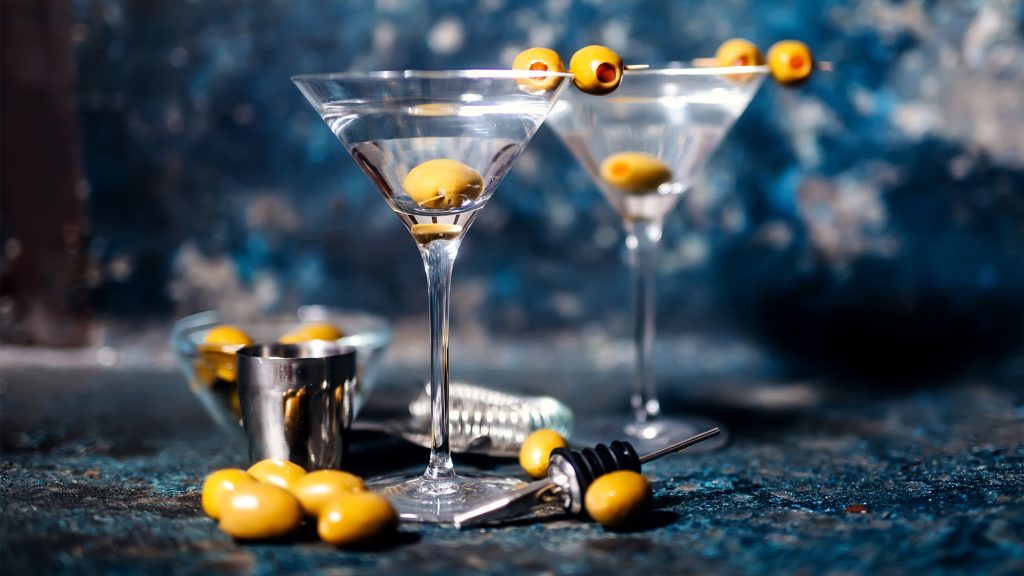
The Martini is arguably the most recognizable cocktail ever created. The highly personalizable drink can spark spirited discussions about its precise specs, but the iconic look of the standard version — clear liquid in a V-shaped glass and adorned by either olives or a lemon twist — provides a foundation almost impossible to confuse. While there have been ebbs and flows to its popularity, the Martini has somehow endured as a reliable symbol of class and sophistication.
It’s also endured more than a few alterations through the decades that deviate from its easily discernible appearance. Some of these variations are visually obvious, while others require tasting them to identify the changes. They all expand the Martini debate, occasionally pushing it toward a liquid existentialism that inevitably leads to the question: When does a Martini cease to be a Martini?
The best way to appreciate the Martini’s evolution is to examine its different enhancements and bastardizations over the past century. Whether some of the enhancements laid out are, in fact, bastardizations is entirely up to the reader’s discretion. But if a certain style pops out as wrong or offensive, that’s only because the classic look has left such an indelible mark on our collective consciousness. Here, we trace the evolution of the iconic cocktail’s appearance, from the creation of the V-shaped glass all the way to tiny ’tini-mania.
1920s: The V-Shaped Glass Debuts
Most people believe the Martini was created in San Francisco as a riff on the Martinez. Some insist it debuted at the Knickerbocker Hotel in New York City. Regardless of origin, the Martini is generally regarded as an American concoction (although Martini & Rossi might disagree with this). The V-shaped Martini glass synonymous with the cocktail, however, has definitive French roots. The iconic stemware made its debut at the 1925 International Exhibition of Modern Decorative Arts in Paris, primarily as a nod to the Art Deco style that was all the rage at the time. Though it definitely made its mark on the cocktail world, the Martini glass has proved to be somewhat controversial as a drinking vessel over the past century. Traditionalists confident in their personal specs adore it, while some bartenders gripe internally about its logistical challenges. From a purely aesthetic point of view? It’s the drink’s most definitive symbol.
1930s: Nick and Nora Make Martinis Cool and Inspire Glassware
Sometimes drinks moments from the big screen can translate into real-life trends, such was the case with Nick and Nora Charles from the 1934 film “The Thin Man” (and its subsequent sequels). The film casts them as a sophisticated, worldly couple whose quick wit and love of cocktails and spirits made them look cool as hell.
So cool, in fact, that they had glassware named after them. In the late 1980s, legendary bartender Dale DeGroff dubbed the collection of tiny coupe glasses he used for cocktails at The Rainbow Room “Nick & Noras” as an homage to the fictional couple. The nickname made perfect sense. In the film’s most famous scene, Nora joins Nick at a hotel bar and orders a half-dozen small-sized Martinis to catch up to her already-imbibing husband, imploring the server to “line ’em up!” The glass endures today as an elegant and sensible vessel for proper Martini consumption, even if the imbiber is unaware of whom the glass references.
1940s: Something’s Missing (It’s the Vermouth)
Acting as the prime minister of England during World War II, Winston Churchill was one of the most influential leaders of the 20th century — his command was even strong enough to shape modern Martini culture. Churchill loved Martinis but hated vermouth. His solution? The Churchill Martini, a riff on the classic that’s essentially 2 and a half ounces of ice-cold gin pulled straight from the freezer. He was known to remark that he would merely glance at a vermouth bottle while the bartender made his drink — and that would be more than enough vermouth. His preference launched a style of ultra-dry Martinis that continues to permeate through cocktail culture to this day. Jokes about looking at the vermouth bottle, waving the bottle over the glass, or whispering “vermouth” into the vessel also persist, despite the fact that there is plenty of damn good vermouth currently on the market.
1960s: James Bond Shakes Things Up
In the 1964 movie “Goldfinger,” James Bond orders a Vodka Martini “shaken, not stirred” and the simple line altered Martini culture forever. It wasn’t the first time someone shook a Martini on-screen. Nick Charles instructed people to shake a Martini to the rhythm of a waltz in “The Thin Man.” But that was at a time before stirred Martinis became the gold standard. Stirring was the default method when Bond ordered the drink, and Martini purists have been complaining about it since the dawn of the craft cocktail revival. Technically speaking, they have a point: Shaking a Martini can over-dilute the drink, giving it a less nuanced flavor. But if shaking instead of stirring made writer Ian Fleming happy, it really doesn’t matter if he was technically right or wrong.
1970s: Vodka Domination and More Ice
Even the classic Martini couldn’t escape the clutches of cocktail culture’s “dark ages.” Vodka Martinis became the preferred version, acting as a symbol of the spirit’s 1970s market supremacy. Those who stuck to gin ordered them bone dry and inadvertently demonized vermouth even further. Occasionally, these drinks were served in a rocks glass over ice, stripping the cocktail of its timeless, elegant look.
The Martini’s biggest change during this era wasn’t how it looked or tasted, but rather how it was perceived. Classic Martinis were viewed as serious drinks that stuffy old rich people would knock back during “three- Martini lunches,” and it was the antithesis of the scene’s increasingly casual vibes. This perception helped popularize one of the weirdest iterations of the Martini ever, the on-the-rocks Martini. This more “laid back” version featured the Martini poured over ice in a rocks glass instead of the traditional, elegant V-shaped vessel. The style is somewhat perfect for a dive bar situation. For a proper cocktail bar? Not so much.
1980s: The Oversized Martini Glass Makes a Splash
Everything was big in the ’80s, and the Martini — specifically, the Martini glass — was no exception. The glasses started growing the previous decade, and they maintained the traditional V-shape as their size increased. By the mid-’80s, they became cartoonish monstrosities capable of holding as much as 15 ounces’ worth of Martini, a far cry from the modest 3- to 5-ounce volume held by the traditional glass. These gargantuan vessels are now somewhat synonymous with the Martinis served up at old-school steakhouses, and they’re perfectly symbolic of 1980s excess in retrospect. Not everyone was a fan: When DeGroff opened The Rainbow Room in 1987, he rejected the idea of serving oversized Martinis and brought in the smaller glasses he’d dub Nick and Noras. But it didn’t matter if the glasses found no quarter atop 30 Rock. They were already the vessel of choice for a new, controversial type of Martini.
1990s: The Martini Goes Technicolor
The word “Martini” was worthless in the 1990s from a traditionalist’s point of view. This decade saw a rainbow-tinted spectrum of colorful, giant cocktails that successfully co-opted the word either by slapping “Martini” or “-tini” to the end of its moniker. While the advent of flavored vodka brands helped launch the trend in the 1980s, drinks like the radioactive green Appletini and the bright yellow Lemon Drop were ubiquitous a decade later, gobbling up wide swaths of cocktail menus at kitschy chain restaurants nationwide. By the time Carrie Bradshaw first ordered a neon pink Cosmopolitan in “Sex and the City” in 1999, it was clear “Martini” wasn’t just a drink. It was a loosely defined category.
2020s: The Tiny ’Tini Movement Takes Hold
The craft cocktail revival in the 2000s hit the Martini’s reset button. The huge, colorful Martini imposters still existed, but over time more people slowly began rediscovering gin, elegant glassware, and even vermouth. And rather than growing in size like previous decades, this time they went in the opposite direction. These tiny ’tinis began popping up on menus in the 2010s, but really blew up in the 2020s for a few reasons. The drink’s small stature allows patrons to enjoy a concentrated blast of Martini deliciousness without succumbing to the overindulgence of a larger version. Ideal for meeting the current moment when many consumers are looking to drink less or have lower-ABV options. It also allows for more variety — why choose between a Gin Martini and a Vodka Martini when you can have two miniature versions of each? And, yes, they look kind of cute when posted on an Instagram feed.
2020s: The Rise of the Savory Martini
The savory Martini’s ascension to menu ubiquitousness this decade shouldn’t be all that surprising. The Dirty Martini was invented in 1901, and it was a favorite during the three-Martini-lunch heyday. Over a century later, bartender Channing Centeno at the Brooklyn restaurant Bonnie’s expanded the drink’s possibilities by adding MSG to the mix. The flavor enhancer kicked down the door to a whole new savory universe — tomato, dill pickle juice, kimchi, and even feta cheese now all appear in Dirty Martini riffs. Plus, these funky creations still manage to feel like a Martini, particularly when they’re served in the classic V-shaped glass.
2020s: The Espresso Martini Has Its (Bigger) Moment
The Espresso Martini was arguably the most famous (or infamous) example of the whole “Martini cocktails that weren’t actually a Martini” trend that dominated the ’90s. Despite its name and the fact it was created by the late British bartending legend Dick Bradsell, it’s still technically not a Martini. But the dark-hued cocktail and its distinctive coffee-bean-trio garnish has not only exhibited staying power when most of its faux-Martini cohorts have not, it’s more popular than ever. The reason why is likely because it’s made with much better ingredients now compared to back then. Sure, the drink makes the Martini purists grumble. But they should only be upset about the drink’s honorary Martini status. Regardless of what it’s called, it’s a great drink.
*Image retrieved from aboutmomentsimages – stock.adobe.com
The article A Visual Timeline of the Martini, From the Dawn of the V-Shaped Glass to Espresso Martini Mania appeared first on VinePair.