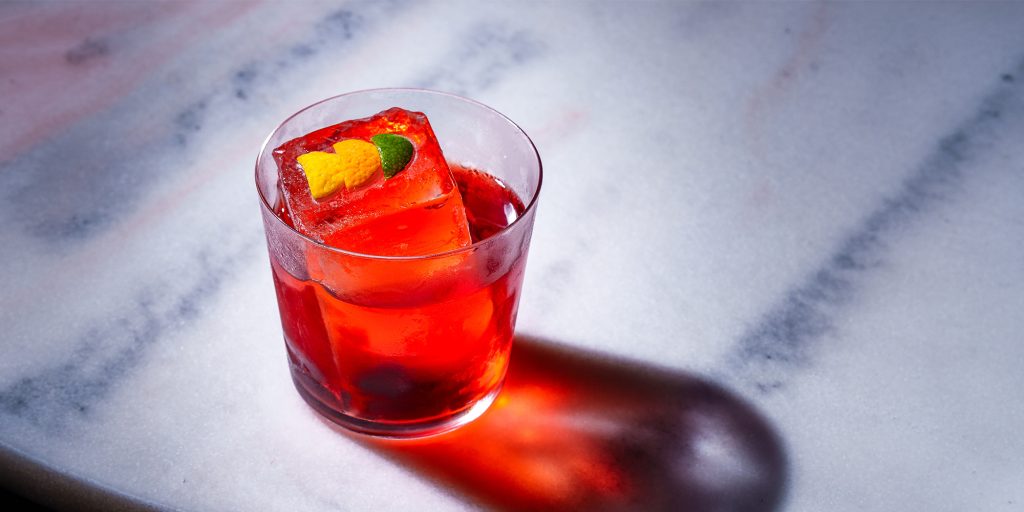
When Gaspare Campari first mixed together equal parts sweet Italian vermouth from Turin and his namesake bitter from Milan even he couldn’t have imagined the unbreakable cocktail foundation he was laying. He began serving the combination at Caffè Campari in the 1860s and dubbed it the Milano-Torino, later known as the Mi-To. The concoction balanced sweet, herbal, savory, and bitter into one vessel, but it was more than just a rich, sippable drink — it was a launchpad to an everlasting realm of cocktails.
The combination of sweet vermouth and Campari became the foundation for classics like the Americano, the Negroni, and beyond. And though the mixture has endured and its associated cocktails have even grown in popularity over the years — the Negroni landing the No. 1 spot on the list of the most popular cocktails in the world for four consecutive years — bartenders have largely remained loyal to the basic tenets of the two-ingredient 19th-century base.
At Miami’s buzzy, aperitivo-centric cocktail bar ViceVersa, which opened in the Elser Hotel in summer 2024, owner Valentino Longo wanted to do more. He strove to take the Milano-Torino and send it into another stratosphere via a careful customization of the core Campari and vermouth pairing. “The original idea was to recreate the family tree of the Negroni,” Longo says.
While Longo is loath to admit it, he became known for his Negroni riffs during prior stints, including as head bartender at The Champagne Bar at the Surf Club in Miami’s Four Seasons Hotel. This time, rather than fixating on how to make yet another distinctive Negroni or Americano variation, he opted instead to conjure up an underlying ingredient that could be deployed across the whole Negroni landscape, a purpose-built Mi-To unlike any other. ”Why not focus on a really good base blend?” he says.
The resulting VV Mi-To is a sumptuous showstopper. It’s nuanced, unfolding one layer at time, different flavors hitting you one after another like waves pounding the shoreline in succession. But you don’t have to take it from me. An early Miami restaurant reviewer said ViceVersa has “the best Negroni in the world.” Dozens of Yelp reviewers and Instagram commenters share the sentiment. “No notes,” said Sophie G. “I can say this is by far the best Negroni I’ve had in the world,” added Cameron F. “Their Negroni wins the prize here,” said Elisa R. “It was superb,” @wellscoffees chimed in on Instagram. But if such everyman fodder — my own included — doesn’t mean much for your discerning cocktail sensibilities, we don’t need to stop there, either.
“I love the Mi-To at ViceVersa,” says Giorgio Bargiani, assistant director of mixology at The Connaught, a bar known for elevating a simple concept into a brilliant, refined one. “It is not just a delicious drink, it also reflects and embodies very different ideas and flavors without losing the original balance and DNA.”
This is no “Manifesto of Nonsense,” as ViceVersa’s latest menu is titled. This is a game changer, an Einsteinian Unified Theory of Everything that supercharges the Mi-To and each of its scions, and very well may end up changing our understanding of the entire cocktailverse as we know it.
An Italian Backbone
Credit: Cleveland Jennings
The Milano-Torino’s beauty stems in part from its simplicity, two ingredients that combine to reach a critical mass and explode into an atomic blast of cocktail fury, far more powerful together than either is alone. The entire Italian aperitivo family with its myriad boozy branches shoots straight up from this sapling. The Americano, with the addition of soda water turning the drink into a long, refreshing libation soon followed; the stiff-backboned Negroni, would join the fray by 1919; the bourbon-spiked Boulevardier popping in shortly after that; and even the Prosecco-topped Sbagliato, which may be called mistaken but was certainly created with intention, would join the club further down the line.
What’s perhaps staggering is that while the drinking world at large knows that Campari and sweet vermouth belong in every one of those drinks, most don’t appreciate that the pairing that started the whole shebang was a known commodity as a standalone drink. “Honestly, it’s extremely rare to see the Mi-To on menus today. Even in Italy it’s almost a forgotten classic,” Longo says.
“It is not just a delicious drink, it also reflects and embodies very different ideas and flavors without losing the original balance and DNA.”
“It’s a combination not just of two ingredients that fit really well together, but a combination of two regions in Italy,” says Alessandro Buonadonna, the head mixologist at Grand Hotel Villa Serbelloni. Buonadonna knows a thing or two on the subject, having spent 21 years serving generous pours of Italian La Dolce Vita from one of the country’s swankiest destinations. The historic luxury hotel is located at the tip of Bellagio on Lake Como, which is north of Milan, though well within its imbibing influence.
“Normally our clients ask for what Italians drink, and I think this is the best way to learn about the culture,” Buonadonna says, while serving up his smoked Negroni featuring a specialty blend of wood and dried local citrus peels torched into a mega-sized snifter, delivering a potent, richly infused smoke. Every Negroni offers the opportunity to deliver a history lesson, each glass in the hand a spirituous textbook offering insight into the old ways.
From Milano-Torino to VV Mi-To
Credit: R.C. Visuals
Traveling back from the shores of Lake Como to the shores of Miami, the VV Mi-To is another beast. But what Buonadonna shares with Longo is an ethos that experimentation only works when proper respect is paid to the historical forebear. “We combine flavors together that honor the original Mi-To but can be used to layer into a cocktail,” Longo says.
Longo’s aim was transforming the Milano-Torino tandem into one whose beauty was found not in its simplicity, but rather in its elaborate construction and complexity. Campari and Cocchi Vermouth di Torino are the two predominant ingredients, making it authentic to its origins. But Longo adds a second vermouth for good measure in the form of Carlo Alberto Rosso. It also features two types of sherry, including Palo Cortado and Pedro Ximénez, as well as Giocondo Cabaret Coffee amaro. A one-liter batch is good for about 25 cocktails, with the bar burning through about 20 liters in a week.
Ah, but we’ve forgotten perhaps the most singular and intriguing ingredient: a house osmanthus water made from Rare Tea Cellar Wild Osmanthus Petals. “Orange with Campari and vermouth is a perfect match, so an orange flower tea is a delightful combination,” Longo says. “It’s delicate yet floral, with a touch of orange essence. Instead of adding regular water, we use that as a dilution to enhance the complexity of the base.”
There was some fine-tuning required, as you might imagine when looking at that list of ingredients. “It was two long days in the months before opening, and we bought, sampled, and tried almost every vermouth available in Florida,” Longo recalls, adding that while current general manager Ryan Wainwright was not yet on the team, he was involved in the process. “We started blending, and we thought we had it on the very first night but retrying it the following day it tasted medicinal, and we had to start from scratch.”
After some more experimentation, Longo eventually hit upon the right proportions. “I believe the orange flower tea and the coffee amaro are what tie everything together,” he says. Wainwright, meanwhile, remains in awe of the outcome. “Still to this day, my favorite shot I have ever had is the VV Mi-To blend,” he says. “It’s a work of art. I hope more people start to understand and appreciate its dance of complexity and sophistication.”
“It’s a combination not just of two ingredients that fit really well together, but a combination of two regions in Italy.”
While osmanthus tea, sherry, and coffee amaro might seem like outlier additions, Longo’s intention was never to make the Mi-To into something it wasn’t, but rather, to showcase it in his own particular way.
“The idea of the original cocktail is super simple and Valentino and the team built complexity, integrating multiple layers of fortified wine and bitters,” Bargiani says. “It takes an Italian staple as a starting point for an array of different choices that make this cocktail personalizable for different palates.”
At ViceVersa, the VV Mi-To is served on its own, à la the original Milano-Torino, and is of course found elsewhere in its range of Negroni-adjacent drinks. As for their Negroni itself, with the Mi-To mise en place already aligned, the recipe is as simple as a 2:1 ratio of the signature ingredient to Bombay Sapphire, spritzed with a Tuscan orange leaf essence, though an expressed orange peel would do the job. The drink is garnished with a trio of half moon-shaped slivers of lime, lemon, and orange peels.
Longo can conjure up plenty of other uses, too. What about a Daiquironi, with rum, VV Mi-To, lime juice, and coconut syrup? Try it in the El Presidente, or mix it with rhum agricole. Jumping off from there, my own brainwaves would love to try it in a Jungle Bird. Options, no doubt, abound.
While the cocktailverse has been hyper-obsessed with rotovaps and the latest high-tech gadgets, sometimes the most meaningful innovations still stem from the past. With a fresh, bespoke take on the Mi-To, ViceVersa manages to play to the strengths of drinking history while boldly steering ahead into the spirituous future.
The article ViceVersa’s Negroni Might Be the Best in the World, Thanks to Its Custom ‘Mi-To’ Base appeared first on VinePair.