On a recent week preparing for trial, Ellie Dupler didn’t sleep for two nights in a row. The 32-year-old attorney, who lives in Los Angeles, often works between 12 and 20 hours per day. By the time she slams the laptop shut, the relatable temptation is to disappear into the couch like a rogue chip packet. “But obviously that doesn’t make for a very fulfilling life,” she says, “so I do try to push myself to do a lot of fun things even when resting sounds better.”
In those moments, Dupler — decidedly not a coffee fan — reaches for an energy drink. Her go-to is a vibrant teal can of Alani Nu Dream Float, dotted with whimsical cartoon clouds and tiny ice cream cones, syrup dripping around the rim. It’s sweet and fruity, “like cream soda,” she says. The 200 milligrams of caffeine inside isn’t usually for productivity. It’s to feel human outside the office: to muster the will to go out with friends after work, play a weekend tennis match, or stay up late during her wedding reception.
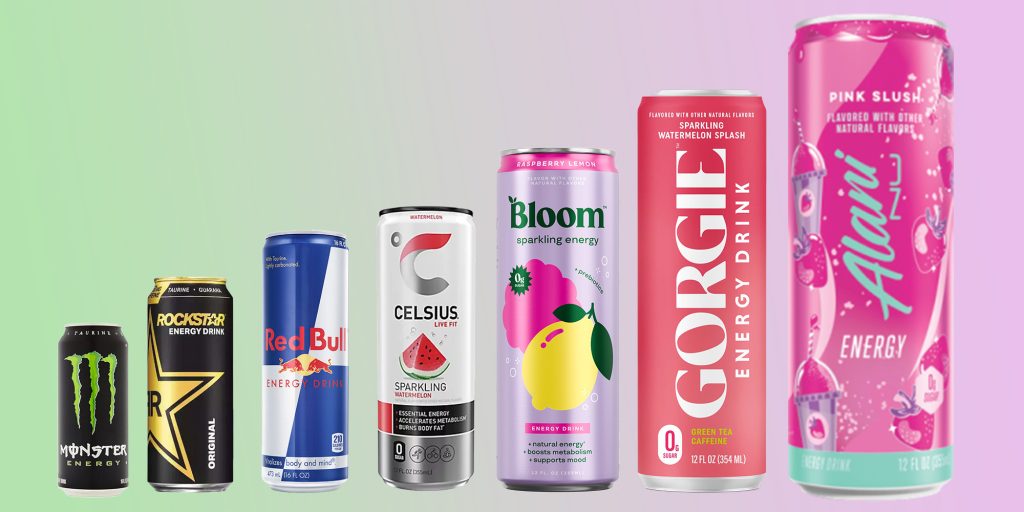
Since the ’90s, energy drinks have been marketed as liquid bravado — housed in black cans slashed with claw marks, stamped with charging bulls, and associated with extreme sports and late-night gaming. These beverages were aimed squarely at men, who consumed the drinks roughly twice as often as women. In the past decade, though, the core energy drink customer base has shifted. As of 2024, the global market was worth roughly $80 billion — and it’s projected to reach $125 billion by 2030. This new interest is largely being fueled by a fresh cohort of female-coded energy drinks, with some brands reporting consumer bases that are roughly half women.
Today, hulking cylinders of dude-juice share shelf space with their visual antonyms. The cans are slimmer, washed in pastels, and advertise soda-esque flavors like “Lime Crush” and “Juicy Orange” alongside promises of mental clarity, metabolism boosts, and mood enhancement. Dupler might work particularly brutal hours, but many women now share her proclivity for an effervescent boost. Only, they aren’t buying energy drinks to skydive from outer space. They’re buying them to keep up with the Sisyphean marathon of modern life.
‘Unleash the Beast’
Despite all the taurine-laced fist-pumping that would come later, energy drinks did not begin as hypermasculine lifestyle accessories. They grew out of functional tonics and pharmaceutical-adjacent beverages, which treated fatigue as a problem solvable with something akin to a multivitamin. Tennessee-bottled, vitamin-fortified soda brand Dr. Enuf, introduced in 1949, was marketed as an answer to various nutritional deficiencies. And Japan’s Lipovitan D, launched in 1962, offered a gentle pick-me-up for truck drivers and factory workers.
The tone hardened with the arrival of Red Bull in 1987. Developed by Austrian entrepreneur Dietrich Mateschitz and Thai energy drink founder Chaleo Yoovidhya, the beverage promised to “vitalise body and mind” and, famously, to “give you wings.” Even as rave-goers sweating in dark rooms spiked it with vodka, the company insisted Red Bull was about performance. As Mateschitz told Fast Company in a rare 2012 interview, the drink’s branding meant to imply that “it provides skills, abilities, power, etc. to achieve whatever you want to.”
Soon competitors followed, and advertisements began to look like the creative output of a roomful of bro-xecutives brainstorming while crushing cans against their foreheads. Rockstar promised consumers they could “party like a rockstar,” Monster urged you to “unleash the beast,” and Red Bull plastered its logo across snowboarding competitions, motocross races, BMX circuits, cliff-diving events, and just about every other extreme sport that could be televised. Even the practically minded Japanese energy-tonic market leaned into the theatrics. A 1989 commercial for the drink Regain famously chanted: “Can you fight 24 hours? Businessman, businessman, Japanese businessman.”
But there are only so many cans of caffeinated machismo you can sell to the same demographic. By the late 2000s, growth in the category had slowed dramatically, rising just 3.1 percent across major U.S. retail channels in the year ending June 2010. Its next obvious customer base was the half of the population companies had spent decades alienating: women. Frances Fleming-Milici, who studies beverage marketing at the University of Connecticut’s Rudd Center for Food Policy and Health, says much of the original energy drink marketing playbook — the “extreme sports, scantily clad women, and gorilla marketing” — still persists. “But now the umbrella is bigger,” she says. “Companies have diversified.”
‘Meet Your New Crush in a Can’
The industry first tried to lure women in the late 2000s. If the problem was that energy drinks looked like the beverage equivalent of The Rock (who now has his own energy drink line), the solution seemed simple: Make them cute. Coca-Cola’s Tab Energy, launched in 2006, was packaged in svelte pink cans and marketed toward women as their “fuel to be fabulous.” In 2011 manufacturer A.G. Barr launched Rockstar Pink in the United Kingdom, emphasizing its low calories on fuchsia and black labels. A year later Flirt Energy Drink returned to the U.S. with “created by women for women” messaging and a sleeker design.
Mostly, these efforts flopped. The intended audience found the approach patronizing. One critic noted that Rockstar Pink was “25 percent smaller than almost every other Rockstar Energy Drink,” joking that if women earned 77 cents on the dollar, apparently their beverages should be scaled down accordingly. “You don’t get those four ounces, but you do get a straw,” the reviewer wrote, lest anyone get highlighter yellow fizz on their glossy lips. “Progress! Yeah!”
Success would ultimately require a rethinking of what “energy” meant to modern women. “They’re exhausted,” says Jessica Calarco, a professor of sociology at the University of Wisconsin-Madison and the author of “Holding It Together: How Women Became America’s Safety Net.” Most women now work full-time while continuing to manage the bulk of the housework, caregiving, and emotional labor in their families and communities. On top of that, she adds, is the constant pressure to optimize their bodies, careers, and public personas enough to “be the one picked for the opportunities.”
Londyn Crenshaw knows the feeling. The 26-year-old freelance event producer and content strategist lives with an ever-growing to-do list and no clear endpoint. “At 3 p.m. my workday doesn’t have two hours left,” they tell me. “It often has four.” Being “young and in New York,” Crenshaw still wants to go out and see friends, but they live with chronic fatigue — sometimes needing “more energy to keep up.” So they occasionally reach for an energy drink to help them work longer or stay out on a night when tiredness might otherwise win.
“Chugging Monster gave me the ability to jump out of the shower and do full glam in record time.”
The real breakthrough came when companies stopped selling masculine rebellion and started peddling self-optimization in a can. Celsius, founded in 2004, spent years languishing on the margins before a mid-to-late-2010s repositioning — shifting the drink from a jargon-y thermogenic, “negative-calorie” supplement to liquid fitness — helped propel its runaway growth. The formula wasn’t much different from its predecessors (caffeine, guaraná, B vitamins), but the fantasy of effortlessly snatched bodies was. Between 2020 and 2023, sales increased tenfold. A new customer base had been tapped, Ellen Cushing recently wrote for The Atlantic, “by exploiting a different set of unattainable aspirations, using a different vocabulary.”
Competitors quickly followed. Alani Nu, founded in 2018 by fitness influencer Katy Hearn and her husband, scaled rapidly through social media and national retail distribution before being acquired by Celsius for $1.8 billion last year. Bloom markets “natural energy” from green-tea caffeine alongside prebiotic fiber and mood-boosting benefits. Gorgie bills itself as an “energy drink with benefits,” complete with vitamins and, in some versions, added protein. While Update, a brand that promises caffeine-free energy, recently announced a relaunch backed by Kim Kardashian.
The insinuations about femininity are not always subtle — and some consumers have noticed. When Monster announced FLRT — pitched as “your new crush in a can,” — the overtly gendered branding sparked backlash from drinkers questioning why a beverage needed to be pinked-up at all. Crenshaw, for one, bristles at hyper-feminized marketing. “It feels very late-stage capitalism-y,” they say. Red Bull, still the top-selling energy drink in the U.S., feels more neutral to them, a product that doesn’t suggest they should be “losing weight or something.”
But recognition doesn’t blunt the strategy for everyone. Marketing research suggests that product aesthetics often function as gender signals, with color, shape, and packaging design influencing whether consumers perceive a product as masculine or feminine. Dupler says she drinks Alani Nu primarily because she likes the flavors, but admits the packaging helps. “You could put a nice label on anything and suddenly I’m like, ‘Oh, that’s cute! Those look so fun,’” she says. Sometimes she splits a can with her husband, who also loves Alani. It’s the kind of cross-appeal energy-drink companies have increasingly sought as they try to broaden their audience.
The Exhaustion Economy
If the first wave of energy drinks was about conquering the external world, this one largely seems to be about conquering the self. Maria Davison, a 22-year-old baker in Bountiful, Utah, relies on Red Bull to get through stressful shifts. She has ADHD, autism, and an auditory processing disorder, and says the drinks help her keep up with production expectations in the kitchen. One recent morning, Davidson tells me, she downed two cans, put in headphones, and powered through seven batches of cookie dough that had initially felt insurmountable. “I started shaking,” she says, “and then I just got to work and I made it in the perfect time.”
Her coping strategy isn’t unusual in a country where structural problems are routinely addressed at the individual level. Sociologist Adia Wingfield, who studies workplace inequality at Washington University in St. Louis, points out that modern jobs increasingly demand long hours and constant availability without social policies like paid leave and universal healthcare to buffer those pressures. The burden of this system “isn’t distributed evenly,” she says. White women may be able to outsource household labor “because of a certain level of economic privilege and affluence,” but that work is frequently performed by immigrant women and women of color navigating unstable schedules and fragile care networks of their own.
“When the big ways to achieve security and stability feel out of reach, people look for small things that make life feel joyful.”
The same capitalist economy that markets energy drinks to upwardly mobile women often depends on the invisible exhaustion of others to sustain it. Within that environment, a can of magical-sounding caffeine starts to look like a bargain. When workers are already “stressed out” and dealing with “competing burdens,” Wingfield says, it makes sense that an energy drink would feel like the fastest way to get through the day.
But that doesn’t mean the product is a real answer to burnout. Fleming-Milici argues that brands do more than respond to this exhaustion; they help frame the culturally acceptable response to it. The modern energy drink is not just caffeine but “a bit of a status symbol,” she says, proof that you’re busy, ambitious, maxed out, and still “in the game and working hard.”
These beverages are also stepping into the cultural space alcohol once occupied. Folu Akinkuotu, a 36-year-old food writer and baker in Cambridge, Mass., recently drank a can of Monster’s Mango Loco in the shower while getting ready for a Jade Thirlwall concert. In her 20s, she says, the pregame rinse usually involved Champagne or cocktails. But “chugging Monster gave me the ability to jump out of the shower and do full glam in record time,” she says — even though she had just returned from Japan and hadn’t even unpacked yet.
The anecdotes I heard while reporting this story all differ, yet they share a thread. Energy drinks offer something to women that’s as elemental as productivity, thinness, and beauty: They inject pleasure into the daily grind. Many describe genuinely enjoying the flavors, drinking them socially as much as professionally. When I ask Calarco about the significance of these little treats, she says, “When the big ways to achieve security and stability feel out of reach, people look for small things that make life feel joyful.”
Perhaps this is where I should admit that I’m on a slippery slope. I started trying energy drinks for the first time in over a decade while writing this — you know, “for research.” I also happen to be more burned out than ever: I recently finished writing my first book, work back-of-house as a baker, feel like I owe it to my health to workout frequently, and am writing this article on a flight back from a bachelorette weekend that wasn’t energetically or financially smart. I’ve found all of the new brands vile so far, because I cannot stomach fake sweeteners, but the chemical sorcery inside does make me feel like a goat striding up my mountain of tasks.
I might not think twice about this newly forming habit if Fleming-Milici hadn’t explained the consequences. She tells me the industry’s wellness pivot has made powerful stimulants appear benign. “When you put a health halo on products, it deceives consumers,” she says. Claims about “natural” caffeine, weight loss, or beauty benefits can make energy drinks seem beneficial, even though many contain twice the caffeine of a cup of coffee, and the mix of added stimulants may amplify caffeine’s effects. When consumed in excess, energy drinks have been linked to symptoms ranging from heart palpitations and seizures to serious cardiovascular complications, particularly among adolescents, who are increasingly guzzling from the ever more colorful cans.
In the aughts, downing a can of Red Bull or Monster wasn’t just about getting ahead; it became an easy way for young men to perform a Bear Grylls-style masculinity. Those who bought into traditional gender ideals were more likely to believe energy drinks made them perform better, and those beliefs were linked to men drinking more of them. Doctors encountered the physiological fallout of that cultural script in emergency rooms across the U.S. And now the industry is capitalizing on a different one that’s already been written for women. It’s built on stamina, good looks, pristine health, and cheerful overwork. What could possibly go wrong?
The article From Dude-Juice to Metabolism Boosts: Energy Drinks Enter Their Feminine Era appeared first on VinePair.