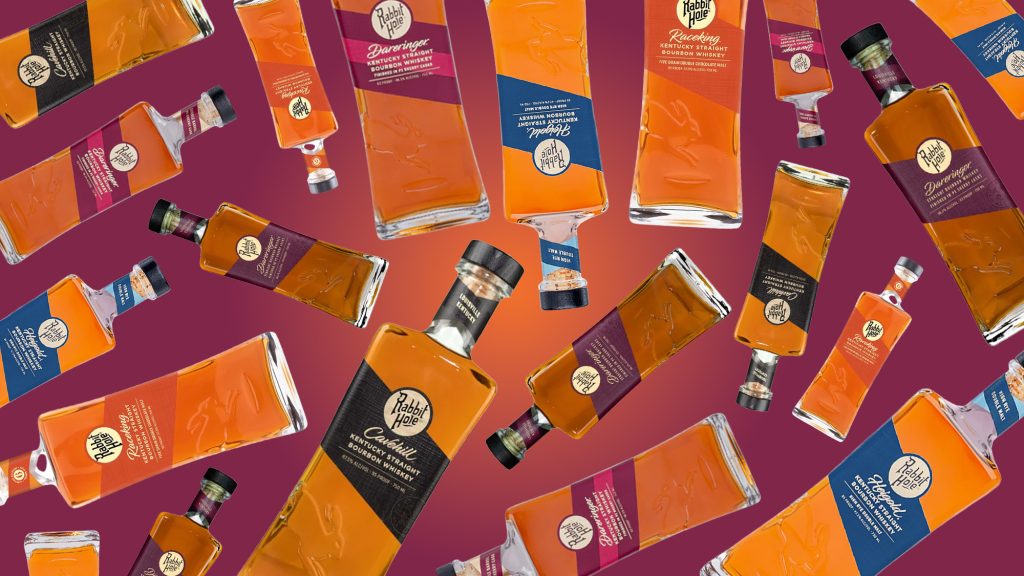
Kentucky bourbon is steeped in American history, and many producers tend to stick to tradition by mimicking classic mash bills and tried-and-true aging methods. At Rabbit Hole Distillery, however, founder Kaveh Zamanian isn’t afraid to go against the grain. Rabbit Hole is a rebel with a cause: producing spirits that are undeniably American whiskey but distinctive in their own right.
After fleeing war-torn Tehran in 1979 for the United States, Zamanian hopped from Southern California to Phoenix to New York to Chicago. In 2012, he founded Rabbit Hole in Louisville, Ky. — less than 10 years after his first visit to the Bluegrass State. Now, Rabbit Hole is a go-to bourbon for bartenders, and much of that appeal comes from the distillery’s unabashed willingness to diverge from convention, playing around with an ex-sherry barrel aging here and a Japanese oak finishing there. As Zamanian puts it, “Bourbon is 51 percent corn and 49 percent possibility.”
From Zamanian’s unconventional career switch to Rabbit Hole’s idiosyncratic production methods, here are seven things to know about the Kentucky whiskey brand.
Zamanian began his career as a clinical psychologist.
After landing in the U.S. and moving multiple times, Zamanian settled in Chicago for college, graduate school, and the early years of his career. He began as a clinical psychologist and psychoanalyst and practiced for over 20 years. Zamanian’s first alcohol-industry-adjacent gig was during his studies when he worked behind the bar to fund tuition and everyday expenses. He particularly took to bourbon after meeting his wife, Heather, who hails from Louisville and helped him fall in love with the spirit.
Bourbon is at the forefront, but Rabbit Hole offers another whiskey variant.
The first words that populate the website’s homepage are “Original Works of Bourbon” — understandably so, as Rabbit Hole is a bourbon-first brand. However, the distillery’s portfolio also includes a rye bottling. Of the brand’s “Core 4” products, three are bourbons — Cavehill, Dareringer, and Heigold — and one is a rye called Boxergrail.
The brand’s atypical mash bills yield distinctive flavors.
With each of his bourbon mash bills, Zamanian dials into his creative philosophy. Other than the legal requirement that corn make up at least 51 percent of the mash bill, there is no set-in-stone recipe for bourbon, but rarely does the typical whiskey include as much malted grain as Rabbit Hole’s. Take, for instance, Cavehill, the brand’s flagship bourbon. Its recipe consists of 70 percent corn and 10 percent each of honey-malted barley, malted barley, and malted wheat. Amping up the malt yields a sweeter flavor profile with headlining notes of caramel, butterscotch, and brown sugar.
The distillery also produces clear spirits.
Rabbit Hole first expanded its lineup beyond whiskey in 2020 by releasing a gin. After distillation, the Bespoke Gin is aged in ex-Boxergrail barrels, which impart rye’s typical spice, mellowing the gin’s piquant juniper flavors. The brand dove further into clear spirits with Liddel Vodka. The name comes from Alice Liddel, who inspired Lewis Carroll to write “Alice in Wonderland,” the story that is, of course, contingent on the titular character falling down a rabbit hole.
Rabbit Hole suggests pairing its bourbons with cheese and charcuterie.
An entire page of the distillery’s website is labeled “Bourbon & Boards” and lists the distillery’s suggested cheese and charcuterie pairings to go alongside its “Core 4” whiskeys. When drinking Cavehill, Rabbit Hole suggests eating aged gouda and mortadella or bresaola. It advises pairing Heigold with sharp, aged cheddar or double-crème Brie and prosciutto or salami. Dareringer, on the other hand, goes well with goat cheese and finocchiona. Lastly, Rabbit Hole recommends noshing on mimolette, cheese curds, beef salami, or speck while sipping on Boxergrail.
The brand’s name wasn’t inspired by the literary fairytale.
While “Alice in Wonderland” turned the rabbit hole into a symbol for the unknown, the tale wasn’t the direct source of inspiration for the distillery’s name. In the early stages of building the distillery (from scratch, without prior experience in the industry), Zamanian’s wife told him he was “taking the family down the rabbit hole.” Because the rabbit hole in question was his business, Zamanian felt it was a fitting name.
Rabbit Hole’s property is a beloved pit stop on the Kentucky Bourbon Trail.
The Kentucky Bourbon Trail is studded with longstanding, historic bourbon distilleries like Old Forester, but newcomer Rabbit Hole is one of the most celebrated stops on the route thanks to its state-of-the-art infrastructure. The distillery is known as the “new architectural icon” of the Kentucky Bourbon Trail as it’s housed in a contemporary building with angular, metal exteriors and floor-to-ceiling glass windows. The property, which cost $15 million to build, includes the distilling, barreling, and bottling facilities as well as an on-site bar for visitors to enjoy.
The article 7 Things You Should Know About Rabbit Hole, the Bourbon Distillery Breaking Tradition appeared first on VinePair.