While most tourists in Barcelona spend their days relaxing on the beach, admiring the architecture, and ordering countless plates of tapas, a certain set of cocktail enthusiasts use this precious vacation time to wait in an hours-long line in the sun — all for a chance to score a seat at powerhouse bars like Sips or Paradiso.
What drew in these eager drinkers was the pull of the World’s 50 Best Bars list — on which Sips and Paradiso currently rank No. 3 and 4, respectively. The highly regarded list has drummed up hype for a number of bars since its inaugural launch in 2009, bringing worldwide fame to spots like Double Chicken Please, Handshake Speakeasy, Bar Leone, and Superbeuno.
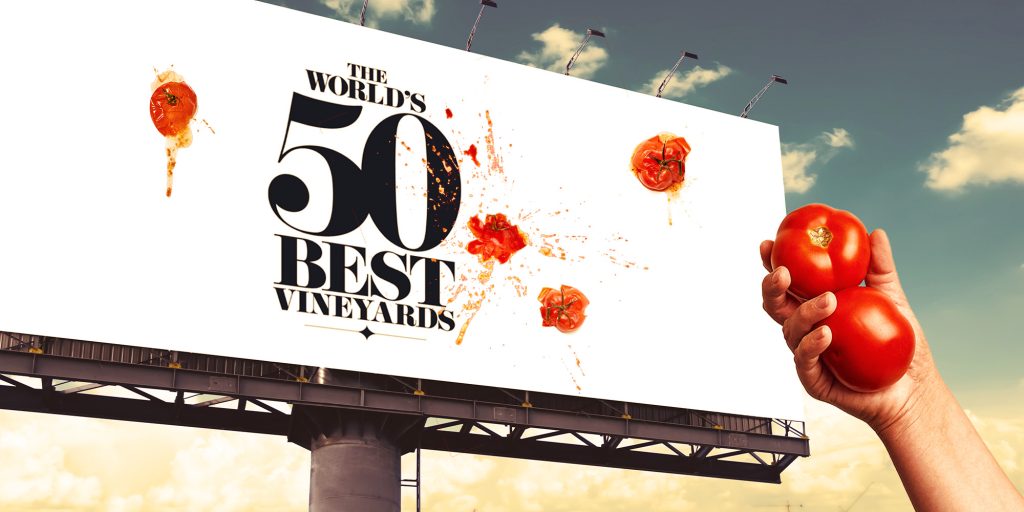
In November, 50 Best expanded its coverage with the debut of its 50 Best Vineyards list, joining the 50 Best Bars, 50 Best Hotels, 50 Best Restaurants, among others. William Reed — 50 Best’s parent company — had launched the list in 2019, but 2025 was its first year under the 50 Best name. Each year, hospitality workers and consumers alike wait anxiously for the awards to drop. But when 50 Best released the 2025 vineyard list, it resounded more like a flop.
To industry folk, it was immediately obvious that 50 Best opted to showcase big-name producers whose priorities lie more in the aesthetics than the quality of the wines. Vineyards on the list feature high-end hotels, 18-hole golf courses, and original Picassos. They have glitzy tasting rooms and pampering spas.
“These aren’t even the best vineyards in their regions, let alone the best region. It seems like more of a travel blog than an actual serious list for the wine world.”
Moments after 50 Best posted the list on Instagram, a swarm of eyebrow-raised users flooded the comments. Many criticized the list for ranking based on the grandeur of estates’ amenities over the merits of the vineyards, belying the title of the award. “Not a single one from Burgundy means that the list obviously isn’t serious,” one user said. Others speculated a pay-for-play situation: “I wonder how much it cost to get a spot on this list.”
50 Best is a worldwide beacon of influence in the hospitality sector, where consumers around the world flock to find standout places for bites, drinks, and hotel stays. And the brand recognizes the influence it carries: On its website, 50 Best refers to itself as “the leading authority in global gastronomy and the international drinks scene, showcasing worldwide trends and highlighting great restaurants and bars from all corners of the Earth.”
But with that authority comes a heightened responsibility to deliver objective, quality recommendations to listening consumers who are willing to spend portions of their income on the brands it recommends. Instead, 50 Best Vineyards is a list riddled with questionable assessment criteria and confusing goals.
Tourism or Terroir?
It’s evident that the World’s 50 Best Vineyards was largely designed to target big-pocketed tourists. But with a name that postures as ranking the best vineyards — not the best tourism experiences — its blurred lines threw many for a loop. So how does 50 Best determine the “best vineyards” if not by measuring soil types and slope aspects?
To select and rank the recipients, 20 academy chairs — each representing a region around the world — handpick 720 voters. Its website claims there are no criteria on which voters assess vineyards. But head of content for 50 Best Emma Sleight says there is one requirement: The vineyards must be open to the public.
“It’s billed as ‘The World’s 50 Best Vineyards,’” says wine critic, sommelier, and Instagram personality @thepeoplessomm. “The perception is the vineyard. It’s not the experience. If you’re doing the world’s 50 best wine destinations, some of this makes more sense. But vineyards? No.”
Sleight admits that 50 Best recognizes the criticism in its branding and acknowledges that it can improve how it communicates its core goals. “We do stipulate that it is very much about the vineyard experience,” she says. “It is geared toward celebrating those experiences on a vineyard over, say, the paramount of wine quality or growing grapes at the vineyard.”
When 50 Best launched its restaurants list in 2002, it quickly made a name for itself by ignoring the overwrought, white-tablecloth establishments that its top competitor — the Michelin Guide — continued to cover. Instead, 50 Best was known for favoring the avant-garde.
“It’s the usual suspects getting airtime rather than actually supporting the wine industry as a whole, which has some phenomenal independent producers.”
“When [the restaurants list] first came out, it felt like it was hitting a mark that otherwise wasn’t being hit,” says Kyle Paton, an Ontario-based importer who worked at highly acclaimed restaurants like Blue Hill at Stone Barns when the brand was gaining traction. “50 Best was pretty spectacular because it was shining a light on people actually doing amazing things in the world of food.”
Sleight claims the motivation behind publishing a vineyards list is to bring attention to incredible venues and the people behind them, similar to that for the restaurants.
But among the biggest disappointments of the vineyards list is that its ethos does not match that of the other rankings. 50 Best postures as a recommendation source that celebrates “up-and-coming chefs and bartenders” and highlights “the subtlety and complexity of various cuisines and drinks cultures from around the world.” And while the 50 Best Restaurants list is notoriously exclusive, the 50 Best Bars program recently doubled down on its efforts to expand its reach to lesser-known regions: The current list features bars from Bratislava, Slovakia, and Tirana, Albania.
There isn’t much ‘up-and-coming’ about the vineyards list: Maison Ruinart and Champagne Taittinger, two of the most famous and longest-standing estates in France, populate the rankings.
London-based importer Richard Bracken says the list perpetuates the already-established producers with the financial ability to invest in luxurious grounds, which is maladaptive to the rest of the industry. It eclipses the small, independent producers who otherwise would have benefited from the publicity.
“It’s hard enough for these small producers to get some airtime and get people drinking their wines,” Bracken says. “When I saw the list, I was like, ‘It’s the same, old, well-established, massive marketing-budget producers. It’s the usual suspects getting airtime rather than actually supporting the wine industry as a whole, which has some phenomenal independent producers.”
Sleight says one of 50 Best’s goals with the list is to stimulate worldwide oenotourism. As 50 Best Vineyards remains in its early days, the list might see the inclusion of smaller wineries in the future, similar to the progression of 50 Best Bars. “It’s designed, by subjective nature, to be dynamic, so we envisage it changing and growing with more new entries coming in over the years,” Sleight says.
Trends in the Trade
The success of the 50 Best Bars franchise undoubtedly lifted the global cocktail scene to new heights, and as the wine industry continues to struggle, it could use a similar jolt of energy. But the lists received vastly different reactions from the trade.
While bartenders admire the 50 Best Bars list and seek to work with those featured at the top, the wine industry found the best vineyards list out of touch.
“These aren’t even the best vineyards in their regions, let alone the best region,” Paton says. “It seems like more of a travel blog than an actual serious list for the wine world.”
Will Piper, wine director at The Four Horsemen in Brooklyn, finds that lists like these don’t hold actual weight in the wine trade. “No one’s going to publish a 50 Best list and have it be meaningful,” says Piper, who helms one of the most important and influential wine programs in New York City. “Something like this is hyperbolic. And to the 1 percent that are going on these Picasso wine junkets, God bless. I hope they enjoy.”
This is also seen in the fanfare around the award ceremony itself. Well-known bartenders and spirits brand reps from around the world attended the 2025 50 Best Bars ceremony in Hong Kong. Interested viewers could watch the massive celebration on a livestream as the host made their way through each number of the list with growing anticipation — a far cry from the social media response to the 50 Best Vineyards announcement.
“It is geared toward celebrating those experiences on a vineyard over, say, the paramount of wine quality or growing grapes at the vineyard.”
Despite the lackluster response from the trade, the list had a sway on consumers: Some of the top-ranking wineries reported significant positive responses to the list’s publication. VIK, the Chile-based winery ranked in the No. 1 spot and Alexander Valley’s Jordan Vineyard and Winery both reported a significant uptick in sales, tasting room visits, hotel bookings, and social media followers after the list’s release. In just 24 hours from its publication, Jordan saw a 26 percent increase in sales.
Another Missed Opportunity
Just two weeks after 50 Best released its 2025 vineyards list, the Michelin Guide announced it will also add wine to its repertoire. Instead of stars, Michelin will award wineries “grapes” to signify the quality of an estate. The first rendition of Michelin Grapes will launch this year with a scope limited to Bordeaux and Burgundy — two of the most prestigious (or, expensive) regions in the winemaking world. (And notably, two regions that already have recognized ranking systems.)
The Michelin Grapes announcement on Instagram was met with a similar hesitation, with many commenters dubious about the methodology. “Many wineries will certainly start chasing the Michelin Grapes rather than just simply focusing on the real ones. As scores don’t do enough of that already,” one user commented.
At a time when the wine industry is considering how to reroute the ways it reaches consumers, these lists rely on a tired strategy: exclusivity. These luxury wines and wineries are out of reach for most consumers.
It’s unclear if a list like this featuring small-scale producers would be the correct answer, though. Spotlighting them on a far-reaching list might skyrocket their demand to levels they can’t meet. “If you put Kenjiro from Domaine des Miroirs [on the list], it would ruin his life,” New York-based natural wine importer Zev Rovine says. “People already try to show up at his house all the time. He [operates] a tiny winery in his house. He’s not looking for wine tourism.”
Whether either distinction is beneficial for the wine industry at large remains to be seen. But based on initial reactions, it seems unlikely. As these out-of-touch list-based ranking initiatives continue to miss the mark, the wine industry’s rut drags on.
“It’s a missed opportunity,” Bracken says of the independent wineries he represents. “Well, it’s an opportunity taken by the people on that list because they’ve probably made a fortune out of it.”
The article Why the World’s 50 Best Vineyards List Misses the Mark for the Wine Industry appeared first on VinePair.