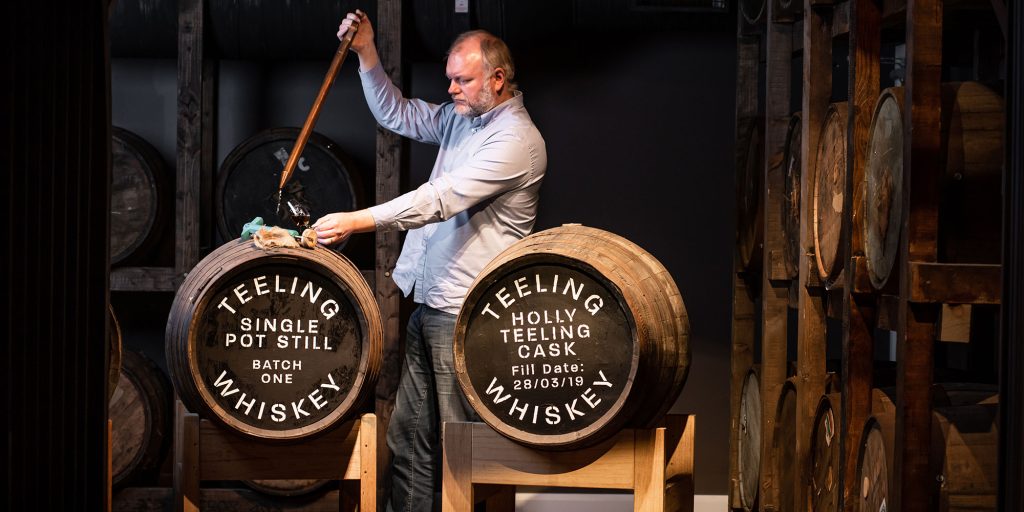
In 2010, there were four distilleries in Ireland: New Midleton, Cooley, and Kilbeggan in the Republic of Ireland, and Bushmills in Northern Ireland. In 2020, there were 32. And as of late 2025, there were around 50, the result of both real category growth and the belief Irish whiskey can further expand its international appeal. (In some ways, one might compare it to America’s own bourbon boom of the 2010s.)
Fast growth has necessitated new infrastructure, ranging from grain supply to distribution networks. It’s also created demand for a whiskey ingredient as important as water, yeast, and grain: the distillers themselves. And though Ireland has incubated home-grown distilling talent, a lot of those folks are coming from America.
Between the Irish and American whiskey industries, exchanging knowledge, personnel, and even flavor profiles isn’t exactly new. The two industries have closely linked history dating back hundreds of years. Today, Irish distillers lead a number of American distilling teams, including Kentucky giant Heaven Hill (Conor O’Driscoll) and Minnesota’s Keeper’s Heart (Brian Nation, formerly master distiller at Midleton, the distillery behind Irish whiskey giant Jameson).
But the presence of American distillers in Ireland is its own phenomenon. Among operating Irish distilleries, at least four are currently led by American-born and educated master or head distillers — and we’re likely to see more in the coming years. To learn more about why so many end up in these roles, I spoke with the American distillers from Teeling, Boann, Midleton’s Micro Distillery, and Blackwater. Ultimately, their prevalence is a result of multiple factors — some personal, some professional — along with a shared passion to grow a centuries-old whiskey-making culture.
Ireland’s Call
It’s estimated one in 10 Americans claim some form of Irish ancestry. For Barrett Stapleton, the connection was more direct than most. Born in California, Stapleton grew up with dual U.S.-Irish citizenship and maintained close ties with Ireland through his father’s family. After finding a passion for homebrewing and then whiskey, Stapleton worked as an electrician in Hawaii. Eventually, Ireland’s pull was too strong to ignore.
“I was dedicated to finding a way back,” says Stapleton, who landed his first Irish distillery job in 2021 and became head distillery at Midleton’s Micro Distillery in 2023. Today, Stapleton oversees a purpose-built innovation center within Ireland’s largest whiskey producer. His work influences the decades-long pipeline for Midleton products, as well as experimentation for the Method & Madness brand.
For some American distillers, the attraction to Ireland comes via marriage. Alex Chasko, master distiller at Teeling in Dublin, and Boann’s head distiller Alex Witt are married to Irish women they met while living in the United States. Each started in Irish whiskey only after making the decision to relocate across the Atlantic.
“With my wife being from Ireland, it just made more sense,” Witt says. “She has a very large family, and I didn’t think it would be fair to make her live so far away from home. … And with two young kids, having that support so close is invaluable.”
Credit: Alex Chasko for Teeling Whiskey
Chasko says that while his family’s move wasn’t well timed on paper — landing in Ireland in 2008 as the financial crisis hit — it happened to coincide with the rebirth of Dublin’s long-dormant distilling scene. And in 2012 an opportunity opened up for Chasko to join budding distillery Teeling as its first employee.
“Jack and Stephen [Teeling] were building a new distillery in The Liberties, a part of Dublin that had been a powerhouse for whiskey more than a century ago but had gone relatively quiet,” he recalls.
And for other Americans in Irish whiskey, making the move was just good business.
“I got a call from a good friend of mine who was consulting for Blackwater at the time,” says John Wilcox, who currently runs Blackwater’s distilling team. “[A] few months later I was in Ballyduff building our whiskey program.”
Credit: John Wilcox for Blackwater Distillery
Wilcox cut his teeth in Alaska’s craft brewing scene before making the leap into distillation. To him, the American presence in Irish distilling is a secondary effect of the bourbon boom.
“I think it’s less about Americans specifically and more about timing,” he says. “The U.S. craft distilling boom kicked off in the mid-2000s, so there’s now a generation of distillers with 10 to15 years of practical experience. Craft distilling in the U.S. didn’t always offer a clear vertical ladder. Most of us moved diagonally. You’d go from one small distillery to a slightly bigger one, take on more responsibility, more creative influence, a better title, better pay. A true journeyman experience.”
“Single pot still is the most interesting, dynamic, and diverse distillate in the world. You really can’t find another spirits category that has such depth and history.”
Unsurprisingly, many ambitious Americans built skill sets at U.S. distilleries or breweries — and were (or still are) looking for a next challenge. For them, Ireland offered a rare opportunity to make an impact on one of the world’s oldest distilling traditions. And numerous Irish distilleries were happy to welcome that talent. Wilcox doesn’t see the trend ending anytime soon.
“Now that the industry is expanding globally, there’s a real demand for people who’ve lived through that first growth wave,” Wilcox says. “There just aren’t enough experienced distillers in the pool yet to meet demand, so you’re seeing some importing of labor.”
Diving Into Pot Still
The distillers I spoke with all have a particular passion in common: single pot still Irish whiskey. The oft-misunderstood style is made with both malted and unmalted barley, leading to a unique and adaptable range of potential flavors. Traditionally, it’s also been made with other cereals like oats and rye, though the modern definition limits usage of non-barley grains to 5 percent.
Credit: Barrett Stapleton for Midleton Micro Distillery
“What excited me about working in Irish whiskey was single pot still, which really drew me to Midleton,” Stapleton says. “Single pot still is the most interesting, dynamic, and diverse distillate in the world. You really can’t find another spirits category that has such depth and history.”
Similarly, for Chasko, the role at Teeling was a chance to help rebuild Dublin’s position as a center for pot still whiskey production.
“Historically, Dublin had its own distinct style, particularly around pot still distilling, with mash bills that combined malted and unmalted barley and a focus on texture and spice. That heritage gave us something real to build from.”
Witt’s interest in pot still whiskey dates back to 2017, when he wrote a university honors project about the role of oats in historic pot still mash bills.
“When I interviewed for the position at Boann and told them about my work with oats, it was truly a serendipitous match because they were planning the Vintage Mashbill program with Fionnán O’Connor.”
“People are exploring what Irish whisky can be, taking bold risks, reviving an industry that only just a few decades ago had nearly been extinguished.”
In contrast, Wilcox’s pot still revelation came later on — well after he had already accepted his current role.
“I have a lot of experience working with mixed mash bills, mostly with bourbon or rye, but before working at Blackwater, I hadn’t played around with oats or unmalted barley,” he says. “Embarrassingly, I didn’t know much about pot still until after I got the job offer. Even more embarrassing (don’t tell the boss) I didn’t taste pot still until I moved to Ireland.”
Fortunately, Wilcox says, he was a quick study. And with no background in pot still, he didn’t feel personal limitations on what the style of whiskey could achieve.
“I was flying blind,” he says. “On the flip side, I came in with a clean slate, zero preconceived notions about pot still, and a metric sh*t ton of enthusiasm. I love a good challenge.”
Shaping a New Era of Irish Whiskey
Unsurprisingly, all four distillers I talked to shared excitement for Irish whiskey’s future, even as the industry navigates the impact of tariffs and a recent contraction in demand. Dublin’s Roe & Co. paused production and Killarney Brewing & Distilling Co. closed in 2025. Both Waterford and Powerscourt are freshly navigating receiverships. But for producers, those headwinds also come with the opportunity to define a new era for Irish whiskey.
“People are exploring what Irish whiskey can be, taking bold risks, reviving an industry that only just a few decades ago had nearly been extinguished,” Wilcox says. “The last decade was explosive growth. New distilleries. New brands. A lot of excitement.”
”Not everyone will survive; that’s just the reality of any boom cycle,” he adds. “But the producers who do will have a strong sense of who they are and what they stand for. … [D]espite the economic challenges we might be facing at the moment, there’s probably never been a better time to be part of the beautiful chaos that is the Irish whiskey industry. The people behind the brands are resilient, stubborn, and full of piss. It’s an honor to be part of it.”
From a pure innovation perspective, Irish whiskey also boasts some unique advantages. Unlike whiskeys like bourbon and Scotch, Irish whiskey doesn’t need to be aged in oak. For Stapleton, a critical part of Midleton’s innovation pipeline involves other wood species.
“When you look at something like Jameson Triple Triple, a triple-casked and triple-distilled profile, we were able to do full maturation of chestnut that unlocked interesting and dynamic flavors by tapping into a whole species of wood that isn’t oak,” he says.
“We have lots of spirit in cask that is currently labelled as ‘Irish Whiskey’ as the amount of oats, wheat, and/or rye used are outside the current allowance by the Technical File. This change will greatly increase the variance of Irish Pot Still Whiskey.”
Chasko and Teeling are also well underway with aging experiments, and they’re currently aging whiskey across over 300 different cask types. To him, the category’s growth also links back to single pot still whiskey’s adaptability, which could get a boon in the near future: Proposed changes to the Department of Agriculture’s definition would expand permitted inclusion of non-barley gains from 5 to 30 percent.
“For a long time, Irish whiskey was described in fairly narrow terms, but that’s already shifting,” Chasko says. “There’s a renewed appreciation for single pot still whiskey, more willingness to explore mash bill diversity, and a deeper understanding that fermentation and distillation shape character just as much as a cask finish does.”
Boann’s Witt shares similar optimism for the proposed change. Like a number of other distillers, he’s already begun producing new mash bills in anticipation.
Credit: Alex Witt for Boann Distillery
“We have lots of spirit in cask that is currently labelled as ‘Irish Whiskey’ as the amount of oats, wheat, and/or rye used are outside the current allowance by the Technical File,” he says. “This change will greatly increase the variance of Irish pot still whiskey to give a broader depth of character to Irish pot still whiskey of the future.”
For adventurous distillers, Irish whiskey presents a unique sandbox to play in. It’s steeped in history, yet undeniably ripe for innovation. It doesn’t take mental gymnastics to look through their eyes and imagine the appeal.
Additionally, working in Ireland itself offers potential benefits beyond what one might find stateside.
“Don’t get me started on the stark differences between U.S. and Irish sick leave laws and mandatory holiday allocations,” Wilcox says. “You mean to tell me I can be sick and it’s not docked against my holiday time? Absolutely mind-blowing.”
The article Why American Distillers Are Thriving in Ireland appeared first on VinePair.