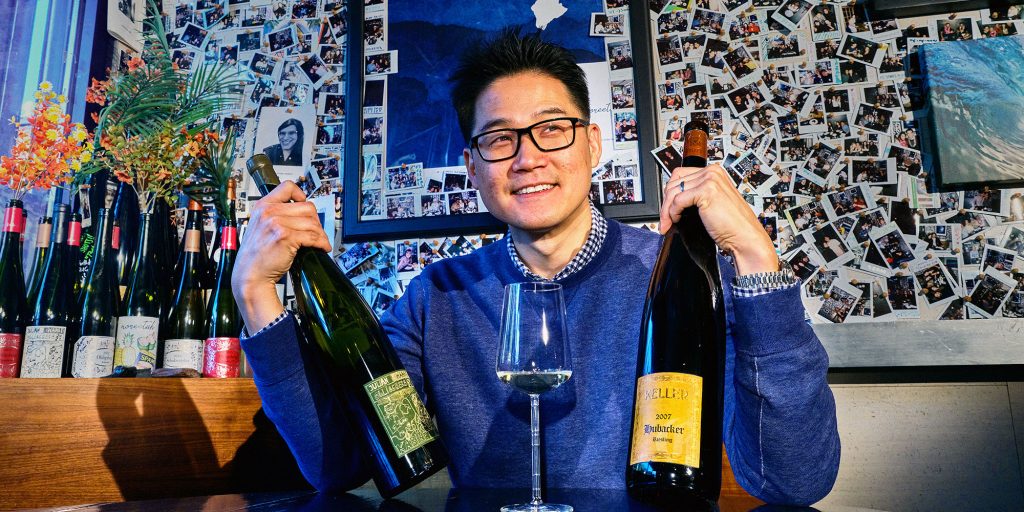
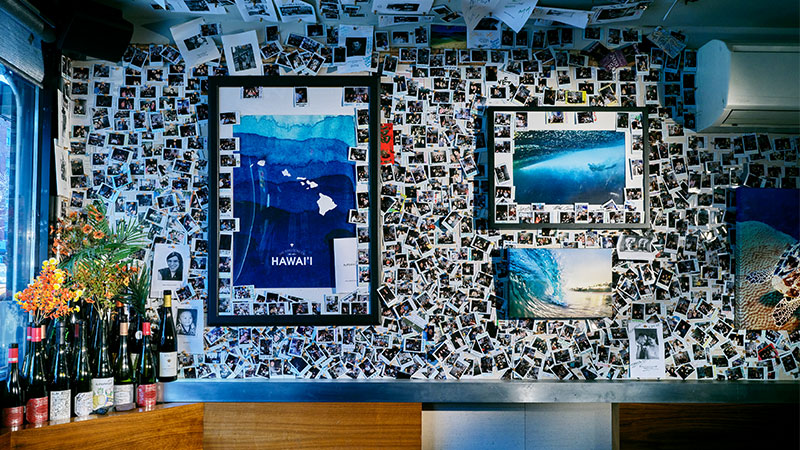
A funny thing happens on Sunday nights in New York City’s East Village. While many of the neighborhood bars and restaurants empty out, a steady stream of patrons carrying wine bottles makes its way down First Avenue to a small Hawaiian restaurant. As the rest of the city chases away the Sunday scaries with takeout and television, sommeliers and collectors congregate at tightly packed tables. Beneath mini Polaroids of guests that cover the walls like mosaics, they sip Riesling, swap bottles, and nibble on musubi.
Since it opened 10 years ago, Noreetuh has become a go-to spot for the wine trade and aficionados. At the helm is Jin Ahn, the Riesling-slinging co-owner. With an ever-changing list of rare wines at shockingly affordable prices, a welcoming BYOB policy, and a sense of camaraderie that envelops even first-timers, Noreetuh has quietly become one of the greatest places to drink wine in New York City.
Ten years in, VinePair takes a close look at how Noreetuh created one of New York’s most welcoming wine communities and the de facto gathering place for the trade.
A Fine-Dining Blueprint
Ahn, a New York native, started in the industry on the service side, waiting tables, as many wine professionals do; however, his introduction to wine made the position more multifaceted. “While I was growing up, I had no experience with wine,” he shares. “I come from an immigrant family. There were no alcoholic beverages in my house. As I worked longer and longer in restaurants, I became more familiar and also started to appreciate what wine does. It’s a social glue.”
He recognized that wine created more conversations and connections with guests and eventually developed an intellectual interest in the beverage. As his career brought him to positions in iconic fine- dining restaurants such as Jean-Georges and Per Se, his palate expanded, and he took every opportunity he could to learn about wine. Ahn found himself drawn to aged wines and credits the patronage of clients as contributing to his education. “Fine dining also brought in certain types of individuals who want to share their knowledge, and sometimes who want to share a glass of wine,” he says.
When he and his business partner, chef Chung Chow, opened Noreetuh in 2015, that fine-dining ethos came with him — but quickly, he discarded it. He found the old playbook didn’t apply to his vision for how a restaurant should be: warm, welcoming, and democratic when it came to wine appreciation.
Redefining Hospitality
In Ahn’s fine-dining days, an invisible barrier of decorum kept servers from getting too close to guests. “There was a fine line,” Ahn recalls. “But I like to engage with the guests, connecting and talking about the wine. It really expands the type of conversation that you can have with the patrons.”
“Jin is instrumental in making people feel welcome,” says sommelier Eun Hee Kwon. She started going to the restaurant when she was transitioning from a corporate career into wine and says Ahn’s support and the Noreetuh community were foundational as she changed industries. Through Ahn, she met other members of the trade and formed new connections. Above all else, she credits his mindset toward hospitality as the biggest learning of her career.
“For Jin and the staff, this is fine dining, as everything they do is intentional,” she says. “I think a lot of us, myself included, sometimes have this preconceived notion of what fine dining is or how hospitality should be. Jin really helps you restructure your thinking around what it means to be a really good establishment for fine dining, in whatever sense. It’s not the white tablecloths; it’s having hospitality in mind, first and foremost, for everything that you do.”
Democratizing the List
Ahn always rallied against standard wine list markups, which, to this day, remains a tenet of the restaurant. His opening menu mimicked what he learned in fine dining — older bottles, Bordeaux, and Burgundies — but $5,000 bottles of wine felt ludicrous. Ahn went on the hunt for a list that felt both exciting and accessible. With these criteria in mind, and with a love for aged wine, Ahn turned to other sources, like the auction market.
Always on the hunt for what he calls value, he seeks wines that “deliver,” as he puts it. “I think people understand what the market rate is on these wines at restaurants. If you could bring it down to the point where it seems like there’s a good value, people will [respond].” To him, this signifies that the restaurant cares about its wine program and cares about the guests’ experience. And once a few discerning diners caught on to the value-driven list, Noreetuh’s popularity snowballed.
This approach certainly helped it rise as a favorite spot for the wine trade. “Whenever industry people from out of town come in, that’s one of the places I love bringing them,” Jonathan Eichholz, MS, who has been going since 2017, says. “Many are really surprised to see what is on the list and the accessibility of those bottles.”
Eichholz also notes he’s always taken aback by the number of international guests who know about Noreetuh. “It’s fun to see that over 10 years, not only is it a beloved neighborhood restaurant, but it’s very much in the ‘IYKYK’ universe of hospitality professionals around the world,” he says.
Ahn admits that it’s “very, very difficult” to maintain Noreetuh’s list, especially since he changes it weekly. And not just maintain — evolve. “I think that evolution is an important thing, and it’s OK not to be perfect at all times. I mean, if you’re going to do something, you might as well do something cool, right? I hate boring lists,” he says with a laugh.
What Noreetuh may best be known for, however, is Riesling, especially German Riesling. Ahn’s penchant for the grape sprang from an opportunity to buy aged bottles from a private cellar, which sent him down a rabbit hole. Flip through Noreetuh’s list, and there are pages dedicated to single producers; a section devoted to Rieslings over 25 years old; and another one for Rieslings younger than 25 years. Through his personal notes and educational quotes from critics at the top of every page, Ahn’s commitment to Riesling is clear.
“I think with Riesling, there’s this reputation that it’s hard to sell, and that it’s so confusing and that no one understands it,” says Stephen Bitterolf, founder of Germany-focused importer Vom Boden. “Jin has probably found through Noreetuh that as long as you do the work, you give a general context, and have enthusiasm and a genuine passion, people are attracted to that.”
Bitterolf counts Ahn not just as a good customer but as a close friend. “He has been one of our biggest champions in New York, and, frankly, one of the greatest ambassadors for German wine.” Through the restaurant, “he’s become an advocate on a deeper level,” Bitterolf adds, nodding to Ahn’s friendships with producers.
The Art of BYOB
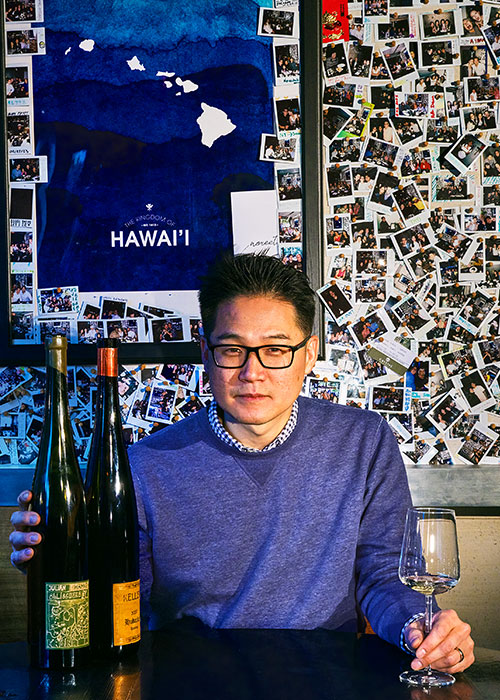
Ahn credits wine-sharing experiences as a formative part of his wine education, and works to pay that generosity forward to Noreetuh’s guests with a generous BYOB policy.
“One of the promises I made to myself is that I want to make it simpler for people to bring bottles of wine,” he says. “Sure, the economics behind it are hard. But one thing that I always showed is appreciation for the wine, and an appreciation for the people who bring bottles.” For the first five years of business, Ahn didn’t charge a corkage fee. “Of course, that backfired on me later on, but that’s a separate story,” he jokes.
What his lax policy did enrich was a community of wine lovers. Guests earmarked special bottles to bring to Noreetuh. Eager to share their wines with Ahn, and with each other, Noreetuh became an unofficial wine clubhouse.
The uniqueness of Noreetuh was acutely felt and codified during the pandemic. “When Covid hit, there was a certain group of people who would come very frequently,” Ahn says. “Their logic was that there are a few restaurants that they really care about and want to bring all their resources to save them from collapsing. We have been on the radar for many people, so we developed a really, really unique wine crowd starting from that point.”
Today, Noreetuh is best known for offering $10 corkage on Sunday nights. But the rest of the time, the official policy is $20 per bottle, with the unofficial hope (or expectation) that patrons will also buy off the list, if not that night, then on another visit. It’s a well-respected policy among the regulars.
Building Community
On the Saturday evening after Thanksgiving this year, Noreetuh was packed with regulars. Ahn weaved through the room, casually dropping glasses off here, a bottle off there. Before long, multiple glasses of “you must try this” crowded the tabletops. Dinner service morphed into a dinner party, culminating with a gathering of friends and soon-to-be-friends in the back room, pouring and swapping wines. Beyond the BYOB policy, beyond the killer wine list, what makes Noreetuh stand out from any other restaurant is its community.
Diana Eng, a lawyer, and her husband have been going to Noreetuh since it first opened. In 2016, the couple, avid collectors, started studying for their certified exam through the Court of Master Sommeliers to deepen their understanding of food and wine. Eng recalls one night when she and her husband walked by Noreetuh and peered into what looked like a closed restaurant, save for a crowded table in the back. “Jin waved us inside,” she remembers, “and it was a group of sommeliers blind tasting. He knew we were studying, so we just sat down with everybody and joined in on the blind tasting. We were the only non-industry people at this table.” But that’s the kind of community Ahn cultivates.
“The coolest part about the community is, I feel like it’s one of the few spaces that both professionals and collectors and enthusiasts, whether you just started yesterday, or are pretty deep in your collecting journey, all just hang out and share wine together,” Eichholz says. ”It’s a space that is — I think unpretentious kind of undermines it — just a convivial, joyous space where Jin conducts all these people meeting each other and sharing a love of life.”
The article Noreetuh Turns 10: How a Small Hawaiian Restaurant Became a Fixture of New York’s Wine Community appeared first on VinePair.