This first in a blog series offers a review of discussion that occurred during ARC Advisory Group’s 2026 Industry Leadership Forum. Specifically, it details a keynote conversation held with senior executives from Rolls-Royce, BTX Precision, and MxD.
The New Fabric of Demand: Modernizing Collaboration and Transparency for Real-Time Production
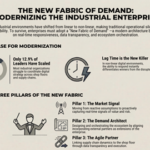
Industrial leaders have been talking about tearing down workflow and data silos for decades. Yet here we are again. For most, the reality is that most operations and supply chains today typically don’t indicate much progress. A few leaders have figured out how to use digital tools to scale and build pathways forward, a whopping 12.9% according to our latest data (yes, that’s sarcasm). However, even as they struggle to coordinate, orchestrate, and innovate across their operations and enterprise, much less tightly collaborate outside their four walls. In a digital world, this continued capability gap, the inability to closely link market signals to responsive production and external supply chains, is very quickly becoming a liability.
Recently, at the 30th Annual ARC Industry Leadership Forum in Orlando, I had the privilege of leading a keynote discussion entitled The New Fabric of Demand: Modernizing Collaboration and Transparency for Real-Time Production. As part of that, I moderated an excellent conversation that included Global Commodity Executive Greg Davidson of Rolls-Royce, CEO Berardino Baratta of MxD, and CRO Jamie Goettler of BTX Precision.
In this four-part series, we will explore that conversation fully, digging into how the “fabric of market demand” has fundamentally changed, and why structural modernization, both human and technological, is no longer just an option. It is an industrial imperative that will increasingly determine who wins in disrupted markets.
Why Legacy Workflow Will Actually Get Modernized
If we examine the present through the lens of the past, the fundamental laws of supply and demand haven’t really changed. What has changed is the hyperconnectivity of the world and our compressed time to both reward and volatility.
The hard truth is that legacy linear workflows simply do not work in hyperconnected, digitally-driven environments, which are non-linear by nature. As our industrial environments become more digital, they naturally open up countless new ways for how things can get done and how risk can enter the organization. As a result, disruption has shifted from a rare event to a fairly continuous and pervasive reality. In this new reality, responsiveness differentiates you from the competition, and lag time kills.
To survive and thrive in non-linear environments, tighter, integrated ecosystems are required, where silos are actively torn down or redesigned so that barriers to value can be continuously identified and quickly eliminated. At the core, this concept is unfolding around data access, contextualization, and sharing. It provides the urgency behind the need for building industrial data fabrics.
This rewiring certainly extends beyond operations and enterprise processes, enabling the entirety of the supply chain to be judged on its collective responsiveness to the market, all the way down to the individual company level. In this scenario, data can quickly point out laggards who limit value. As the orchestrators of these supply chains identify these limitations on value, they quickly break off and discard the connection and move on without these weak links.
Pillars of the New Fabric of Demand
To achieve necessary level of operational and supply chain responsiveness, the roles of every entity within an ecosystem must be rethought. In the subsequent three blogs of this series, we will take a deep dive into the three distinct pillars that make up this modern architecture, but I’ll begin by laying them out here:
The Market Signal is the catalyst of the entire ecosystem. It dictates the “what” and the “when,” defining what value, success and risk look like in real-time. In blog 2, I’ll explore how to move from reactive assumptions to proactively capturing the market signals that actually matter.
The Demand Architect is moving beyond traditional order-taking. The Demand Architect designs and orchestrates the ecosystem, aligning external partners as true extensions of the enterprise. In blog 3, I’ll discuss the structural agility required to lead this response, rather than just manage a process.
The Agile Partner is the engine of execution. The Agile Partner links supply chain dynamics directly to the shop floor, differentiating themselves through their responsiveness to the market signal. In the final blog in the series, I’ll tackle how data transparency and trust become technical requirements, not just buzzwords, without exposing mission-critical IP.
Building the Modern Industrial Enterprise
Legacy workflows cannot survive in a non-linear world. Industrial organizations must re-architect operations and ecosystems for real-time responsiveness and secure, transparent collaboration. To do so, they will need to:
Improve the measurement of responsiveness: Efficiency and margin-squeezing are important, but they aren’t game-changers. Your competitive edge now relies on how quickly you can adapt to market signals.
Embrace transparency over secrecy: Modern collaboration requires providing a contextualized “lens” into production status without compromising proprietary IP or cybersecurity. Industrial data fabrics are key.
As always, view technology as a tool, not an outcome: Industrial data fabrics are needed to break silos and AI to manage complexity and improve accuracy and speed of decisions. However, the age-old adage remains true. Just because you can apply AI to something doesn’t mean you should. It must be grounded in measurable Value on Investment (VOI), not just return.
The New Fabric of Demand Blog Series
This is the first in a series of four on The New Fabric of Demand: Modernizing Collaboration and Transparency for Real-Time Production. Over the coming days, I’ll publish a perspective from each of the three pillars of the new fabric of demand:
Pillar 1: The Market Signal
Pillar 2: The Demand Architect
Pillar 3: The Agile Partner
By Mike Guilfoyle, Vice President.
For more than two decades, Michael has assisted organizations, including numerous Fortune 500 companies, in identifying and capitalizing on growth opportunities and market disruption presented by the effects of digital economies, energy transition, and industrial sustainability on the energy, manufacturing, and technology industries.
The post How to Capitalize Quickly to Address Hyperconnected Industrial Demand appeared first on Logistics Viewpoints.