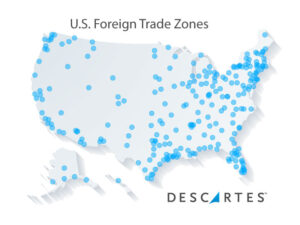
In 1934, when Congress passed the Foreign Trade Zone (FTZ) Act and established the FTZ program, the U.S. economy faced a policy environment similar to today’s: high (and prevalent) tariffs and heightened concern for protecting domestic industries and encouraging domestic investment. Then, as now, policymakers sought mechanisms to help U.S.-based companies stay competitive in the face of escalating costs by offsetting the burden of high tariffs.
For decades, FTZs have been used actively and on trend with overall U.S. import and export statistics, providing importers, exporters, and manufacturers with a toolkit to manage customs duties, streamline operations and bolster cash flow. Today, however, recent tariff actions on steel and aluminum that for most countries doubled to 50% under Section 232 of the Trade Expansion Act of 1962, as well as sweeping International Emergency Economic Powers Act (IEEPA) reciprocal tariffs imposed on nearly all commodities from all countries, have upended global trade and shifted the FTZ landscape significantly.
As trade tensions push import duties to record highs, companies big and small are looking for ways to insulate themselves against tariff volatility and stabilize cash flow against economic uncertainty. While FTZs are resonating as a strategy to mitigate or avoid absorbing higher tariffs into operating costs, the program is not a silver bullet. Instead, FTZ participation in 2025 demands a more nuanced cost-benefit analysis that weighs the traditional advantages of FTZs compared to the current benefits against changing trade policy.
Traditional FTZ Benefits
Licensed by the U.S. FTZ Board, FTZs are secure, designated sites traditionally located within 60 miles or a 90-minute drive from a U.S. port of entry (although FTZ sites now are often located at further points as well), in which domestic and foreign merchandise (i.e., inventory) receives the same treatment by U.S. Customs and Border Protection (CBP) as if it were outside the commerce of the United States. FTZs enable companies to defer, reduce or eliminate duties, depending on where goods end up (e.g., distributed domestically or exported to avoid applicable duties and taxes).
Historically, one of the most important FTZ benefits was inverted tariff relief for manufacturers. Through the Boggs Amendment of 1950 and regulatory clarifications in the 1980s, U.S. manufacturers could import higher-duty inputs, process them domestically, and release finished products into the commerce of the U.S. at lower duty rates of the finished products. This helped manufacturers reduce overall tariff costs, enhance profitability and get on more even footing with offshore manufacturers.
Put another way, it gave U.S.-based businesses federal approval to rationalize what historically was “irrational tariff treatment” in the Harmonized Tariff Schedule of the U.S. (HTSUS). Irrational tariff treatment is when imported parts and materials are assessed at higher duty rates than the finished goods they are incorporated into. Without the ability to invert duty rates, companies would be financially incentivized, from a customs duty treatment perspective, to import finished goods rather than produce them domestically.
Beyond inverted tariffs, FTZs offer additional benefits:
Export relief: Goods brought in and stored or manufactured in an FTZ can be exported in bond without incurring quota charges or U.S. duties, insulating businesses from the adverse effects of tariff hikes. Plus, merchandise exported from FTZs to international customers and subsequently returned can be admitted to an FTZ for storage, repair and export again without being subject to duties.
Cash-flow benefits: The timing of when duties are paid makes a significant difference to cash flow. By deferring the payment of duties until goods leave an FTZ, companies improve working capital. By bringing the duty cost closer to when goods are sold to the customer, companies can shorten the cash cycle and optimize cash flow. Depending on how fast a business turns its inventory, this can be a critical part of a company’s ability to maintain its U.S. operations.
Weekly customs entry and Merchandise Processing Fee (MPF) savings: MPF is paid per customs entry (.3464% against the value reported on the entry) but has a maximum amount today of $651.50 with routine incremental increases each year. However, FTZs permit qualified companies to consolidate an entire week’s worth of shipments out of the FTZ into a single weekly customs entry, thereby creating the opportunity to possibly save broker entry fees and significantly reduce annual MPF spend. Filing consolidated weekly entries is especially appealing for high-volume importers but comes with its own set of complexities in the current trade policy environment.
State and local tax savings: In states that assess ad valorem tax on inventory, such as Texas, Kentucky, Louisiana and Puerto Rico, inventory held in FTZs may be preempted from such taxes through the federal FTZ law. Likewise, some states have codified state-level tax benefits, such as Arizona’s reduction of up to 75% for real and personal property held in FTZs. These tax exemptions and reductions—above and beyond the traditional duty benefits of the program—create additional financial incentives and help further reduce operational costs for FTZ users.
A Changing Trade Landscape
For decades, these advantages attracted a diverse mix of manufacturers and distributors into the program. In 2018, however, key tariff developments began to disrupt the global trade landscape. In January 2018, the U.S. imposed safeguard tariffs on solar panels and washing machines from all sources (except Canada) under Section 201 of the Trade Act of 1974. In March 2018, Section 232 tariffs on steel and aluminum took effect, with temporary exemptions for Canada, Mexico, Australia, Argentina, Brazil, South Korea and the EU. By June, however, exemptions had expired for Canada, Mexico and the EU, and Section 232 tariffs were imposed.
In April 2018, the U.S. Trade Representative (USTR) released a list of 1,333 China-origin imports for proposed 25% Section 301 duties, as part of a broader and new trading strategy with the East Asian nation. Within days, China imposed retaliatory tariffs of its own on U.S. exports. By June, the USTR proposed a new list of products from China, worth $50 billion in trade, to be subject to Section 301 duties of 25%. These initial trade remedy actions in 2018 were just the beginning of what is now an almost eight-year-long, increasingly complicated but fundamental change in U.S. trade policy.
Interestingly, with the first six months of 2018 also came a pivotal shift in how FTZs function today: a change to mandating the election of Privileged Foreign (PF) status for imported merchandise at the time of admission to an FTZ, which locks in an item’s classification and duty rate on that date. For decades, imported raw materials, components and finished goods were largely admitted into FTZs in Non-privileged Foreign (NPF) status, which requires classification on the item’s condition as removed from the FTZ at the duty rate in effect on the date of entry. For FTZ manufacturers authorized by the U.S. Department of Commerce, NPF status elected for imported parts and components is what drove inverted tariff benefit (i.e., the ability to apply the finished good duty rate to the value of the parts/components consumed in the finished good). With 2018’s new tariff actions, the Administration through the U.S. Trade Representative and the U.S. Department of Commerce began requiring FTZ imports to be admitted in PF status. PF status “locks in” the normal, or Most Favored Nation (MFN), duties and any remedy tariff rates on goods at the time of their admission into an FTZ, which means the imported component’s duty and tariff rates apply even if the finished good made in the FTZ carries a lower duty rate.
What does this mean in practical terms? It means the inverted tariff benefit for FTZ manufacturers was essentially eliminated in April of this year when the PF status admission stipulation began applying to nearly all imported commodities from all countries of origin via IEEPA reciprocal tariffs. Now, existing FTZ manufacturers as well as manufacturers considering the program must recalculate the savings opportunities from FTZ usage. For some manufacturers, the program may continue to make sense or drive even more benefit, while for others the program may no longer make sense. Paradoxically, tariffs intended to protect U.S. jobs are simultaneously hampering some FTZ manufacturers from promoting domestic production, the original intent of the program. If the same finished product is made in another country, under IEEPA reciprocal tariffs, it still offers a lower overall tariff rate when imported than the imported parts and components used to make the finished product in the U.S. If the goal of current trade policy, however, is to reshore and nearshore manufacturing, don’t FTZ manufacturers still need the inverted tariff benefit to rationalize what is otherwise still an irrational HTSUS?
FTZ Advantages Today
What are the main advantages for FTZ users today then? For many importers, it’s cash flow: by delaying duty payments, companies can preserve capital. This benefit, however, depends heavily on inventory turnover. Large retailers cross-docking goods through distribution centers may realize little advantage as goods enter U.S. commerce within days, triggering prompt duty payments. By contrast, businesses holding inventory for weeks or months can extract more meaningful benefit from duty deferral, such as industrial distributors, seasonal retailers, or exporters awaiting foreign buyers.
In the absence of inverted tariffs, the importance of export relief has grown. Manufacturers that ship even a portion of their production abroad can typically eliminate duties altogether on exported goods. For many businesses that traditionally relied on inverted tariffs, this now represents one of the few clear savings opportunities. Additionally, some manufacturers that previously had little reason to consider FTZs are now compelled to join the program precisely to avoid duties on outbound shipments.
While tariff relief is the focus for many, ancillary benefits remain material. Although now more administratively complex, weekly entry/MPF savings continue to appeal to some while the compliance requirements may outweigh the fee savings for others. Inventory and real/personal property tax abatements are still available in states such as Texas, Kentucky, Louisiana, Arizona and Puerto Rico, but these benefits are not guaranteed. They require negotiation with local impacted tax recipients and cannot be assumed across the board. Companies that install imported production equipment in their FTZ production facilities can also achieve duty/tariff deferral benefits on the machinery until it begins being using in production.
Looking Ahead: Uncertainty and Opportunity
The FTZ program is at a crossroads. Its historical role as an engine for tariff rationalization for U.S. manufacturers has been curtailed, but its potential as a platform for cash flow management, export relief and targeted ancillary tax savings is legitimate. In addition, pending litigation, including possible Supreme Court rulings, could dramatically reshape the tariff landscape overnight. A rollback of tariffs could potentially restore inverted tariff benefits for many industries and commodities, while new tariff exemption frameworks could offer parallel relief.
For importers and manufacturers, the shift in trade policy has forced more sophisticated supply chain analyses. Establishing and operating an FTZ requires significant time and investment in an extremely complex trade compliance environment. Understanding if setting up and operating an FTZ makes sense in the context of this complexity is not a simple exercise. For tax and finance professionals, determining whether FTZ participation will yield measurable benefit requires a more granular assessment of inventory turn rates and export volumes. Companies must model turnover rates, tariff exposures, and compliance costs in detail to decide whether an FTZ is advantageous for the organization’s unique product mix, trade patterns, and risk tolerance.
Parting Thoughts
For businesses, agility is critical. Companies must reassess FTZ participation regularly, model cash flow implications under various scenarios, and assess measures for ancillary benefits, including engaging with local authorities on property and inventory tax opportunities where appropriate.
For policymakers grappling with the challenge of reconciling tariff policy with industrial strategy, FTZs may represent an underused tool. In an era when tariff policies are used both as protectionist levers and geopolitical instruments, FTZs provide a stable, regulated framework for balancing trade governance with competitiveness.
FTZs are not loopholes. They are highly regulated, overseen by U.S. CBP and the Department of Commerce, and subject to annual reviews and public interest considerations for manufacturers. In many ways, they are better suited to provide equitable tariff mitigation than ad hoc exemption processes. A 2019 econometric study conducted by The Trade Partnership titled The U.S. Foreign-Trade Zones Program: Economic Benefits to American Communities quantified that—all else being equal—employment, wages, and value-added activity are higher in areas with FTZs than similar areas without FTZs, and that a company’s access to FTZ benefits has substantial positive ripple effects throughout its U.S. supply chain.
And so, as they were conceived, FTZs are an effective mechanism for encouraging domestic manufacturing and facilitating global competitiveness.
By Rebecca Williams, Managing Director, Rockefeller Group Foreign Trade Zone Services and Eric Dalby, VP Support, Professional Services at Descartes
The post Foreign Trade Zones in Today’s Trade Policy Environment appeared first on Logistics Viewpoints.