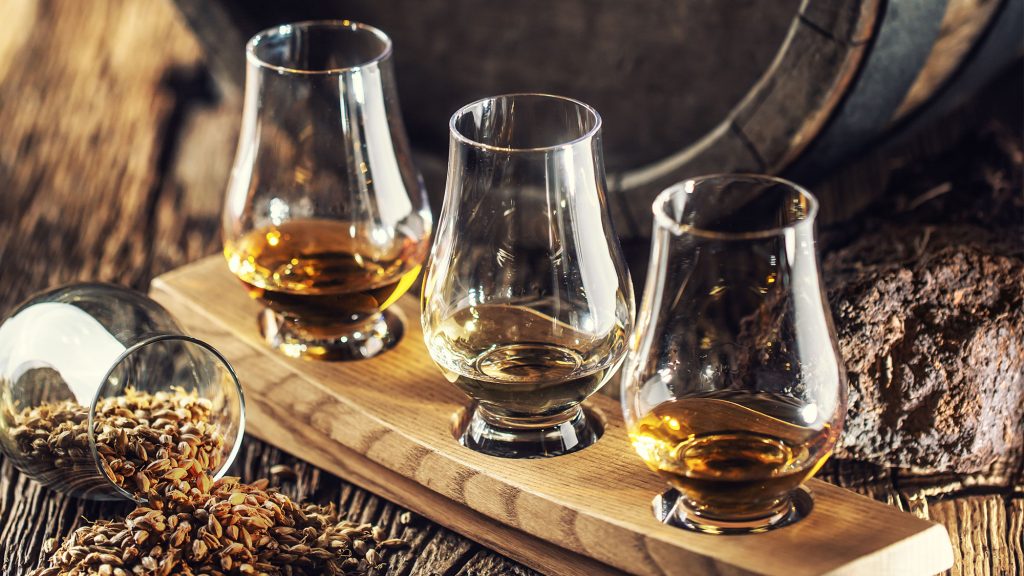
Scotch is one of the most prestigious whisky categories in the world, with the high cost of ingredients and lengthy aging periods pushing the average price of a bottle over $50. Beyond its spendy reputation, the Scotch category at large is also known for delivering a signature, smoky profile thanks to distillers’ use of peat during the malting process.
According to the Scottish government, approximately 80 percent of all whisky produced in the country incorporates some element of peat, but there are still several producers that stray away from using peat smoke in the malting process. It just so happens that one of the most popular to do so is also one of the world’s most expensive: The Macallan.
While The Macallan as a whole is known for its lack of smoky peat flavor, at one time, the distillery was forced to include peat in the production process or risk losing its energy source for malting. To learn more about this period and the motivations behind the decision, VinePair spoke with Molly Melville, brand ambassador for the illustrious Scotch producer.
“Barley has always been at the forefront of our mind, going all the way back to 1824 and our founder Alexander Reid,” she says. “He was a schoolteacher and barley farmer, which gave us a level of detail that other distilleries may not have had at the time, but he was obsessed with the quality of barley going into the whisky.”
Considering Reid’s obsession with the barley used to make The Macallan, preserving its essence during the malting process was of the utmost importance. In the distillery’s early days, this was done by steeping barley in water for two days in order to trick it into germination before it was laid out on a malting floor for one week. Beneath the barley was a coal-powered fire that dried the cereal grains, transforming them into malt for the distilling process.
For peated Scotches, peat — a natural, hand-cut energy resource in Scotland — is used in place of coal. When lit, the peat gives off a thick, smog-like smoke that infuses the barley and later imbues the whisky style with its signature tasting note. But as Melville explains, that’s not the flavor profile The Macallan is looking to achieve. Instead, the two characteristics the producer is consistently looking for are malty and fruity — not smoky.
“Base spirit accounts for 20 percent of the overall product, which doesn’t sound like much, but it makes a serious impact on the final whisky,” she shares. “Malt and fruit are what we wanted to focus on, and it’s why we haven’t continued to try to incorporate peated malts.”
In the 1940s, though, The Macallan was forced to make a decision — select an alternative fuel source or sacrifice the ability to malt its barley. During World War II, the U.K. government implemented widespread rationing of materials needed for the war effort, many of which were also crucial for whisky production. The army needed the wood that would have been used for casks and the coal The Macallan had historically used for malting.
“The World War period really shifted things,” Melville says. “So many of the resources in Scotland were being directed to the war effort, so The Macallan, along with many other Highland and Speyside single malts, started using peat.”
The decision was a natural one to make. Not only is peat an abundant natural resource in Scotland, but it’s a slow-burning combustible, ensuring The Macallan had a reliable supply to last until the distillery was once again able to use coal. Unfortunately, that time didn’t come until 1958 when all coal rations were finally lifted. As such, a large percentage of all whisky produced at the Speyside facility from 1940 to 1958 was distilled from peated malt.
While The Macallan has yet to release (and likely never will release) an expression made from 100 percent peated malt, it has incorporated the peated whisky in some bottlings over the years, and several recently debuted bottles feature a small portion of these rare whiskies. The Reach, for example, is an 81-year-old whisky released in 2022, a key sign that it contains some peated malt, according to Melville. There’s also Time:Space, an 84-year-old expression distilled during this time period that contains some of the smokiness characteristic of peated malt.
In 2021, the distillery released M Black, one of six bottlings in The Macallan M Series, a collection intended to pay homage to the distillery’s six pillars. M Black, representing mastery, contains no minimum age statement, though Melville explains that it is the smokiest expression released in the brand’s history, clueing us in to the presence of peated malt. Because of The Macallan’s status as a single malt, the producer is able to blend several of its own distillates together. As such, M Black won’t be as smoky as traditional Speyside peat bombs, but there’s still enough to take the everyday Macallan drinker by surprise.
That said, good luck getting your hands on a bottle containing any of the elusive peated whisky. Considering the minuscule number of casks remaining from this time period — not to mention the value added from decades of time spent in barrel — whiskeys blended with the spirits retail for eye-watering prices. M Black is the most affordable option, selling for around $4,000, while The Reach, the most expensive, went for over $270,000 at auction in 2022.
The article Famously Non-Smoky, Here’s the One Time The Macallan Resorted to Peated Malt appeared first on VinePair.