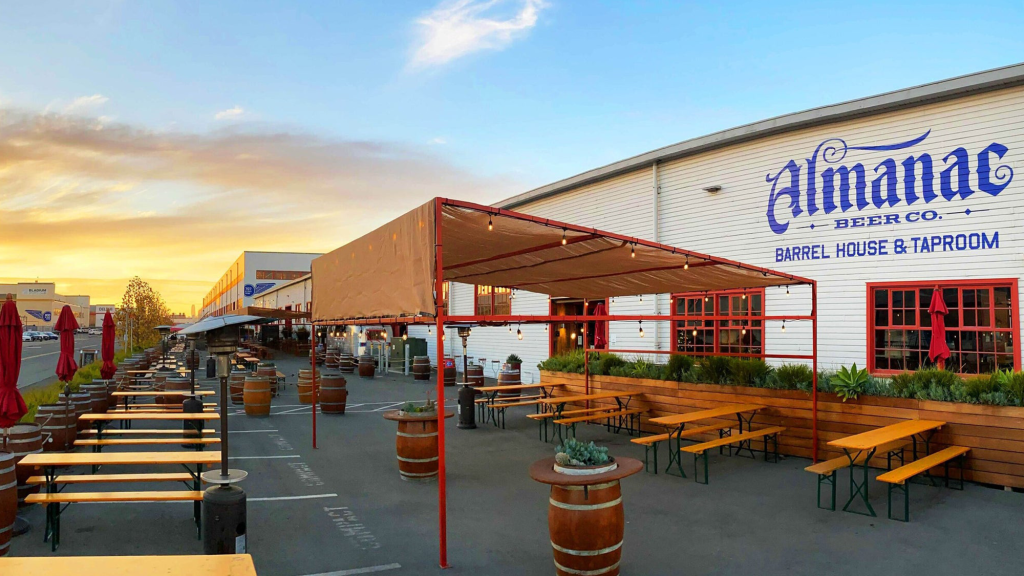
Patrons at Almanac Beer Company in Alameda, Calif., likely don’t know they’re contributing to a larger mission when they pull up to the brewery. Their cars emit carbon dioxide (CO2), as does their breathing, and while polluting the air might not seem like a positive contribution, an on-property air-capture machine recovers CO2 in the environment that’s then used to carbonate the brewpub’s pints. Almanac is the first brewery to do this.
In the brewery’s parking lot, two Aircapture machines handle the work. One captures the CO2, and another liquefies and purifies it to make it safe for consumption. “This beer pulls carbon dioxide out of the air,” says Damian Fagan, co-founder and chief executive officer of Almanac, which he started with Jesse Friedman in San Francisco in 2010. “And it doesn’t cost the consumer anything extra.”
Aircapture — a Berkeley-based company that manufactures “circular carbon economy” machines, or devices that capture ambient CO2 and repurpose it to help curb air pollution — first approached Almanac in March 2025 when a representative walked into the brewery unannounced, Fagan says. After hearing how the rep gave one of the taproom bartenders an elevator pitch with lofty claims about Aircapture’s capabilities, the team at Almanac was skeptical. They thought it was a too-good-to-be-true scenario.
But over a series of calls with the Aircapture team, Almanac’s operations manager vetted the firm and the claims about its technology, and the two companies struck a deal: Aircapture would install the devices in the brewpub’s parking lot and operate them, and Almanac would pay a per-pound rate for the liquefied CO2.
“We honestly didn’t really believe what they were saying up front,” Fagan says. “That led to a number of conversations, and ultimately, we just decided, ‘Hey, this sounds like something worth trying.’”
Over the course of the past year, Almanac and Aircapture worked through the details of their partnership, which led to the eventual launch of their collaboration three weeks ago. It took a year to cement the deal because Fagan and his team wanted to do their due diligence and confirm Aircapture’s assertions plus work out operational and marketing kinks. Now, 20 percent of Almanac’s beer is carbonated with liquid from Aircapture’s devices, and Fagan expects to reach 100 percent by the end of the year.
Fagan says Aircapture approached his team at an inopportune time in the CO2 market and that, in turn, the deal became opportune for his business. Recent factors like the conflict in the Middle East and tax incentives have caused CO2 to become increasingly expensive and its supply chain to be unreliable. In just one instance, an inadequate delivery from his typical supplier forced Fagan to close shop for a few days last fall. Aircapture’s technology has yet to fall short on his CO2 needs, and Fagan has found that a unit of its liquefied CO2 costs 15 to 20 percent less than what he paid for the same amount from his regular suppliers.
“I wish I could sit here and say I was making an altruistic decision about doing something positive for the environment, but the reality is I was making a business decision,” Fagan says. “CO2 was getting more expensive, it was harder to source, and it was creating actual problems with our production. This [partnership] was ultimately solving a problem for us.”
Almanac and Aircapture inaugurated their collaboration with Flow – Clean Air Edition, though the brewery now uses the liquefied CO2 across its portfolio. Flow – Clean Air Edition is a West Coast pale ale featuring a sky-blue label that bears both companies’ logos and is now available on-premises and in cans at grocery and liquor store chains like Whole Foods and Total Wine nationwide. (Almanac already offered a West Coast pale ale named Flow in its lineup, but it was previously carbonated without Aircapture’s technology.)
Other than being uncertain about whether Aircapture’s eco-conscious claims were true or not, Fagan says another big concern was about how air-sourced CO2 would affect the flavor of his beer. “You would never know the difference unless I told you,” he says. “And that’s the best part.”
The article This Brewery Pulls Ambient CO2 to Carbonate Your Pint appeared first on VinePair.