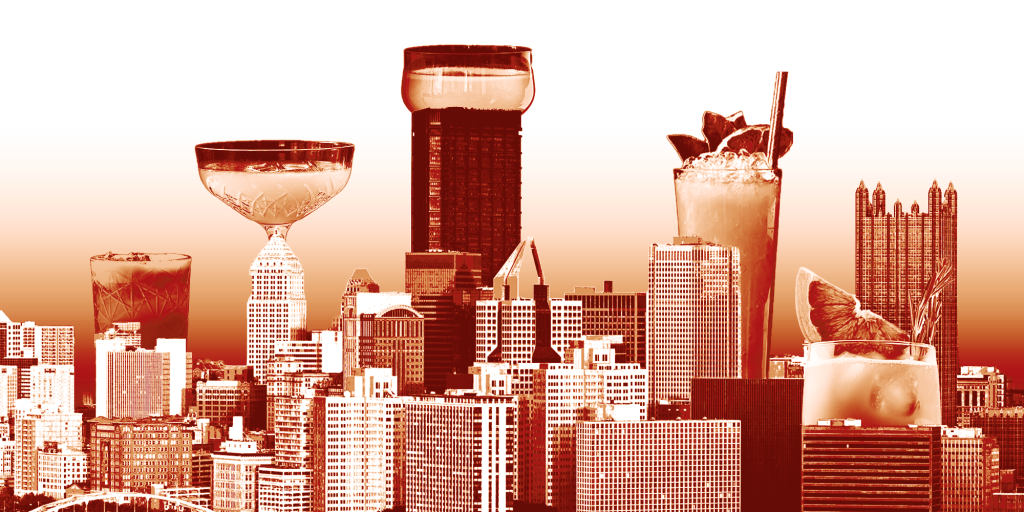
Pittsburgh is a solid example of a hip secondary market. It’s big enough for major professional sports teams and to be the setting for the award-winning TV show “The Pitt.” It’s also gained some traction as an under-the-radar city to visit from a few travel magazines in the last couple of years. At the same time, its population of 307,000 is also roughly 10,000 people fewer than Newark and smaller than several other major metropolitan suburbs. It’s nearly equidistant from Philadelphia and Cincinnati, making it a gateway of sorts between the Eastern Seaboard and flyover country.
These metrics may frame Pittsburgh as a pleasant, charming city to potentially visit. But if the city’s tourism group Visit Pittsburgh has their way, it may also be known as an essential stop for cocktail enthusiasts. In March, they partnered with several of the city’s bars and distilleries to help launch the MixBurgh Foundation, a coalition focused on exclusively promoting the city’s cocktail bar scene. It’s an ambitious play for tourism dollars given Pittsburgh’s current status as an unknown drinks commodity, but it’s also one that may be indicative of how secondary markets use drinks to garner attention in the future.
The Man Behind the Movement
The MixBurgh Foundation is the brainchild of Dale Thomas Vaughn, co-founder of the molecular mixology-focused venue Space Bar in Downtown Pittsburgh. He hatched the concept to promote what he felt was a vastly underrated drinking scene with a vibe similar to other celebrated secondary markets like Austin and Portland, Ore. He also saw this scene as a conduit to challenge the notion of Pittsburgh being stuck in its Rust Belt past.
“Pittsburgh dealt with a hangover when the steel industry shifted, but the city evolved and now is having this weird, creative renaissance moment,” he says. “The cocktail scene makes sense as part of that reinvention.”
Visit Pittsburgh provided the capital, connections, and profile to bring Vaughn’s MixBurgh vision to life. Together, they crafted MixBurgh Weekend, a five-day November fete that, according to the website, is “a coming-out party for a city that has been quietly building something exceptional.” This strategic centerpiece consists of two events: the bar-focused Pittsburgh Cocktail Weekend, and the education-forward MixBurgh Conference. It already carries street cred — it’s nabbed noted drinks writers Robert Simonson and Camper English as guest speakers. Vaughn sees the weekend as an opportunity to promote the innovative ambition that can exist within a secondary market’s cocktail scene.
“If I was in New York, I wouldn’t be able to iterate like I do in Pittsburgh,” he says. “The engine of innovation is no longer on the coastlines. That’s where you can go to show off your skills. But a city like Pittsburgh isn’t constrained by rules and expectations like the coasts. We get to do cool things here.”
A Willing Long-Term Partner
Visit Pittsburgh’s support of a citywide cocktail festival isn’t an unprecedented move. After all, annual festivals like Arizona Cocktail Weekend and Rochester Cocktail Revival get love from their respective tourism boards. Yet the organization’s involvement with the MixBurgh Foundation hits differently, because its partnership isn’t isolated to the promotion of a few days of the calendar. The tourism group’s long-term aim is to create a year-round co-operative marketing campaign that acknowledges a bar scene’s growing potential to attract out-of-towners.
“The cocktail scene is no longer a secondary reason for tourism,” explains Derek Dawson, Visit Pittsburgh’s VP of strategic initiatives. “We had 21 million people come to Pittsburgh last year, and they generated $7 billion in revenue. We see cocktails as a prime driver for that visitation.”
This mindset essentially compelled Visit Pittsburgh to back MixBurgh almost immediately. “Dale’s a convincing guy, but when he came to us with his idea for the MixBurgh Foundation, we didn’t need a lot of convincing to get on board with it,” Dawson states. “Investing in something like MixBurgh and the city’s cocktail scene in a broader sense just made sense to us.”
“Pittsburgh dealt with a hangover when the steel industry shifted, but the city evolved and now is having this weird, creative renaissance moment. The cocktail scene makes sense as part of that reinvention.”
Mixburgh’s campaign could potentially provide Pittsburgh tourism with a bit of a bounce-back: While $7 billion is impressive, it’s a dip from the $9 billion Pittsburgh area tourists generated in 2024. It may also capture the attention of a very specific kind of visitor — the kind who can deliver bright, shiny accolades. This is part of the campaign’s goal: With the James Beard Awards increasing their focus on the importance of cocktails, and awards like 50 Best garnering greater attention among consumers, there’s an increased value in pushing the city’s cocktail culture to a more prominent place.
“Awards don’t matter to me personally, but they matter to tourists,” Vaughn says. “The curators of the lists like 50 Best are never going to come to Pittsburgh by accident. They’re not coming until there’s a purpose for them to do so. If we in the Pittsburgh bar community work together, we can attract that attention.”
MixBurgh’s push toward generating such attention also has the state’s blessing, to the point where they’ve received state funding to bolster the campaign. This is somewhat of an unexpected ally, given Pennsylvania’s notoriety concerning its history of blue laws, the restrictive nature of the Pennsylvania Liquor Control Board’s state-run liquor distribution, and nonsensical liquor taxes. “They see [MixBurgh] as part of the Pittsburgh renaissance,” Vaughn says. “They share similar goals as we do, especially since we don’t want the program to be set up to promote drunkenness and bad decision-making.”
A Valuable Asset Elsewhere
Visit Pittsburgh’s partnership with the MixBurgh Foundation is an ambitious strategy, particularly at a time of economic downturn when people are supposedly drinking less. It’s also an isolated one. Rather than solely focus on the drinks, other tourism boards promote cocktails within the context of general messaging or as part of a food and drink campaign. Dawson feels this could change if the MixBurgh campaign proves to be successful. “I think it could inspire others,” he says. “Ultimately, we want people to look at Pittsburgh and think, ‘We want that in our town.’ We’d love for them to be jealous of us enough to build something on their own in their city.”
Even if other cities aren’t ready to lean into cocktails on Pittsburgh’s level, they’re increasingly acknowledging their value within the context of building awareness of what a city can offer. This is particularly the case in secondary markets, where perception of what a city may be like can often misalign with reality. Tourism boards can use cocktails to turn these misunderstandings to their advantage. In Buffalo, N.Y., they see their cocktail scene as a way to unlock unexpected city secrets.
“Cocktails are often expected in our country’s largest cities,” explains Patrick Kaler, president and CEO of Visit Buffalo. “In a secondary market like Buffalo, it’s a chance to introduce prospective visitors to a side of the city they might not have otherwise known about.”
The element of surprise can sometimes be leveraged to build campaigns that can make cocktail enthusiasts feel like they’re missing out, particularly at a time when awards and nominations for bars and bartenders can garner interest in places that may otherwise be an afterthought. The city of Columbus, Ohio, leans hard into this strategy by using the Tales of the Cocktail nominations earned by venues like Cobra and Law Bird to attract tourists and immerse them in their friendly Midwest vibe. “We’re not top of mind for those outside the city, so the accolades help,” says Leah Berger, director of PR for Explore Columbus. “We want the recognition for our team and for our city, because it helps move the needle.” Their efforts may be working: The greater Columbus area welcomed 53.2 million visitors in 2024 — about 12 million more compared to 2019 — with nearly 20 percent of its tourism dollars generated by food and drink.
“The cocktail scene is no longer a secondary reason for tourism. We had 21 million people come to Pittsburgh last year, and they generated $7 billion in revenue. We see cocktails as a prime driver for that visitation.”
Sometimes, promoting cocktails can be educational. In Milwaukee, their promotion of cocktails aims to recalibrate how out-of-towners view the city’s (and the state’s) legendary drinking habits. “I think there’s a lack of awareness about Milwaukee’s cocktail bar scene because of our association with beer,” says Claire Hanan, vice president of communications and advocacy for Visit Milwaukee. “If you’re in the industry, the scene is an ‘if you know, you know,’ kind of thing. But if you’re not, you may not know. We’re trying hard to change that perception, because the cocktail scene can be a source of surprise and delight for those that only know about the city’s beer culture.”
A Tourism Board’s Best Friend
Even the smallest modicum of promotion toward a city’s cocktail scene can pay dividends for a tourism board, if only because it can make the work of the tourism board easier. After all, a bartender can often be a city’s best concierge. If a person grabs a stool and strikes up a friendly, respectful conversation with the person behind the stick, they will likely leave with recommendations for neighborhoods to explore, under-the-radar attractions to see, and a few cool places where the locals hang out. They’ll receive the keys to the city, making it easier for them to live by the late Anthony Bourdain’s credo of “be a traveler, not a tourist.”
Will other cities replicate Visit Pittsburgh’s stand-alone model to promote their drinks? It’s a mystery now, but it’s certainly not out of the realm of possibility. “I don’t think we’d rule it out,” Hanan says. “Something like that may work out for us down the road.”
“Columbus has our own distillery trail,” Berger adds. “We don’t have a cocktail trail — not yet, anyway.”
Of course, before the MixBurgh campaign becomes ground zero for tourism innovation, it will need to succeed first. This won’t be fully measurable until after Pittsburgh Cocktail Weekend wraps up in November. In the meantime, hope abounds the campaign can give Pittsburgh a shinier star on the map, for its cocktails and beyond.
“I was fortunate enough to go to Austin and Portland when they were at their weirdest. Pittsburgh has a similar vibe,” Vaughn says. “If you go to Pittsburgh for three days, you’re going to have a great time.”
The article Pittsburgh Is Aggressively Courting Cocktail Enthusiasts. Will Other Secondary Markets Follow? appeared first on VinePair.