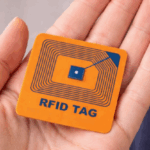
GS1 has released an update to its RFID Tag Data Standard that addresses a long-standing and practical problem in supply chain visibility: how physical items reliably connect to authoritative digital data. The new release, RFID Tag Data Standard (TDS) 2.3, allows RFID tags to carry a web-resolvable domain name alongside an identifier. When scanned, the tag can resolve directly to a URL tied to a specific product, case, pallet, or logistics unit.
At a technical level, TDS 2.3 introduces new Electronic Product Code (EPC) encoding schemes that support embedding domain name information directly in the RFID tag. Instead of returning only an ID that must be reconciled across systems, a read can now point straight to a live data source. That source might be an enterprise platform, a cloud service, or a supplier-managed endpoint containing current, authoritative information about the item.
Operationally, this changes how RFID data is accessed and shared. One of the persistent challenges in multi-party supply chains has not been data scarcity, but uncertainty about where data lives and how to reference it consistently across organizations. By making RFID identifiers web-native, TDS 2.3 removes much of that ambiguity. Logistics units such as pallets and cases can effectively “phone home,” enabling systems and partners to retrieve data without custom lookup tables or brittle integrations.
The most immediate value shows up at the logistics-unit level rather than at the individual product level. Pallets, containers, and cases are where aggregation, handoffs, and risk concentrate, and where clearer data paths produce faster returns. Operators spend less time reconciling identifiers across TMS, WMS, ERP, and partner systems, and more time acting on reliable information. The result is faster exception handling, cleaner handoffs, and better use of RFID data that many organizations already collect but struggle to operationalize.
The update also strengthens traceability in the context of cargo theft and organized retail crime. With theft rates continuing to rise, serialized RFID data that resolves directly to an authoritative source makes it easier to track goods through the supply chain and identify recovered items. When stolen goods are found, origin and ownership can be established more quickly, reducing administrative friction for retailers and law enforcement. This doesn’t eliminate theft, but it lowers the cost and complexity of recovery.
Industry impact will vary. Pharmaceuticals already operate under strict traceability regimes, so the change is evolutionary there. Apparel, general merchandise, and food are likely to see a more meaningful step forward, particularly as traceability and transparency requirements continue to expand. Importantly, the benefits are not limited to large enterprises. By reducing integration complexity, TDS 2.3 makes RFID data more usable for smaller firms as well, improving arrival-time visibility, reducing theft exposure, and potentially lowering insurance friction.
The original catalyst for web-enabled RFID was the European Union’s Digital Product Passport regulation, which focuses on product-level transparency. While that regulation set the direction, the logistics-unit use case has emerged as the more immediate operational payoff. The standard extends RFID beyond identification and into discoverability, clarifying where data lives and how it can be retrieved across systems and partners.
For suppliers and shippers, this also shifts the data-sharing model. With TDS 2.3, a supplier can expose a single authoritative endpoint for certifications, provenance data, handling instructions, or serialization details. Rather than pushing static data to every trading partner, suppliers make data discoverable when it’s needed. That reduces duplication, clarifies ownership, and simplifies dispute resolution across complex distribution networks.
TDS 2.3 does not require new hardware or a new platform. It makes existing RFID deployments more interoperable with modern web and enterprise architectures. By turning RFID identifiers into web-resolvable references, GS1 is addressing a quiet but persistent barrier to supply chain visibility. The payoff isn’t flashy automation, it’s clearer data paths, lower integration friction, and better alignment between physical flows and digital systems.
SEO Meta Title:
GS1’s New RFID Standard Makes Supply Chain Data Web-Native
Meta Description:
GS1’s TDS 2.3 update lets RFID tags resolve directly to web URLs, improving supply chain visibility, traceability, and theft recovery.
The post GS1’s New RFID Standard Makes Supply Chain Data Web-Native appeared first on Logistics Viewpoints.