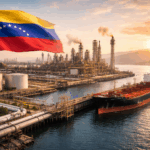
The early headlines around Venezuela’s post-Maduro moment focus on geopolitics and oil diplomacy. Beneath that surface is a broader issue that supply chain leaders should pay attention to. What is unfolding is not simply a restart of oil production. It is an attempt to rebuild a national industrial supply chain that has steadily deteriorated over more than two decades.
Both the Politico reporting and the Americas Quarterly analysis point to the same conclusion: Venezuela’s oil, gas, and mining sectors cannot recover without large-scale private investment. That investment extends well beyond drilling. It includes equipment supply, logistics, ports, power generation, chemicals, labor, financing, and regulatory systems. In practical terms, this is a supply chain reconstruction effort at a national scale.
Recent statements from Venezuela’s acting president add a new dimension to that picture. Acting President Delcy Rodríguez has publicly invited the United States government to collaborate on a shared agenda that includes economic development and respectful bilateral relations, signaling a shift toward diplomatic engagement during the transition period after President Nicolás Maduro’s capture.
From Expropriation to Conditional Re-Entry
Politico reports that U.S. officials are signaling a clear condition to American energy companies. Firms seeking compensation for assets seized years ago would need to return and participate in rebuilding Venezuela’s energy infrastructure. That includes refineries, pipelines, terminals, and operating systems that have experienced years of underinvestment.
This marks a shift in framing. For a long time, Venezuela’s oil sector was treated primarily as a sanctions and diplomacy issue. It is now being treated as an execution issue. Production will not recover through licensing alone. It will depend on whether companies are willing to commit capital and operational resources in an environment where basic industrial capabilities are limited.
From a supply chain perspective, the constraint is not reserves. It is the absence of reliable suppliers, skilled labor, spare parts, transportation capacity, and industrial services.
A Degraded Industrial Ecosystem
Americas Quarterly describes the structural damage clearly. Venezuela’s oil output fell sharply under Maduro, but the deeper issue is the erosion of the supporting ecosystem. Equipment vendors exited the country. Service providers shut down. Skilled workers left. Maintenance cycles were skipped. Power systems became unreliable. Ports deteriorated.
This is what prolonged supply chain degradation looks like at a national level. Even with political change, restarting production requires reestablishing supplier relationships, rebuilding maintenance capability, and restoring basic operational discipline. Many of those capabilities no longer exist locally.
The same challenges apply to gas and mining. Venezuela has substantial natural gas reserves and mineral resources, but bringing them into production requires pipelines, processing facilities, environmental controls, and export logistics that are not currently in place. These are multi-year supply chain buildouts.
Why the U.S. Gulf Coast Is Watching Closely
One important downstream factor is refinery integration. Many U.S. Gulf Coast refineries are configured for heavy crude, which aligns with Venezuela’s production profile. From a refinery supply standpoint, Venezuelan crude is not easily replaced by lighter domestic oil.
If Venezuelan supply were to return reliably, it could influence feedstock sourcing, logistics flows, and pricing dynamics in North America. But reliability depends on operational performance. That performance is driven by port capacity, shipping schedules, storage, pipeline integrity, and contract enforcement. All of these are supply chain fundamentals that require rebuilding.
Rodríguez’s outreach to Washington introduces a potential political channel for supply chain cooperation, but uncertainty remains about how formal coordination on infrastructure and exports would be organized, given the complex legal and political context of the transition.
Investment Risk Is Operational Risk
The hesitation among U.S. oil companies noted in Politico reflects operational risk assessment as much as political caution. Firms are being asked to invest heavily in an environment where supplier qualification must be rebuilt, lead times are uncertain, legal frameworks remain fragile, skilled labor is limited, and environmental obligations are significant.
This is not a narrow drilling decision. It is a system-level commitment. Companies that reenter would effectively take on the role of integrator for a weakened industrial network.
Broader Implications for Supply Chain Leaders
Viewed more broadly, Venezuela is a case study in how tightly supply chains are linked to governance, infrastructure, and institutional reliability. Physical flows depend on legal, financial, and operational systems working together. When those systems break down, recovery becomes a coordination challenge rather than a capacity challenge.
Three implications stand out:
National supply chains can deteriorate in ways similar to corporate supply chains, but recovery takes much longer.
Energy availability depends as much on execution capability as on resource availability.
Political and diplomatic engagement can influence supply chain restoration, but it does not replace the hard work of rebuilding physical networks.
Venezuela’s transition period involves not just resource access but also how governments and firms cooperate to rebuild an industrial base that has been degraded for years. The decisions made now will shape supply flows and investment patterns in energy markets for years to come.
The post Venezuela After Maduro: Why This Is a Supply Chain Story, Not Just an Oil Story appeared first on Logistics Viewpoints.