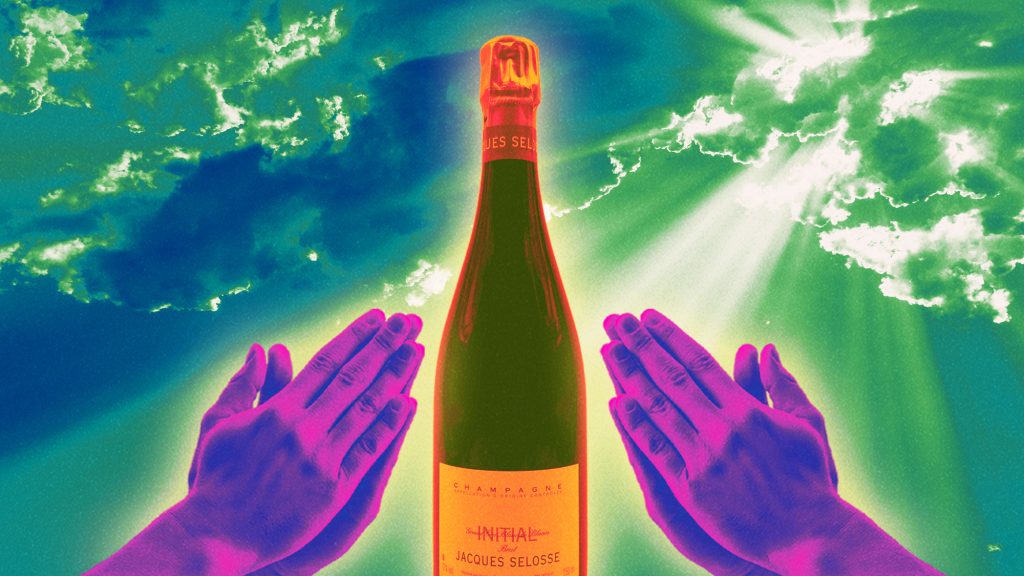
Burgundy might not be an obvious training ground for a Champagne producer, but for Anselme Selosse of Champagne Jacques Selosse, it set the groundwork for his wines — and altered the Champagne region as a whole. Prior to his influence, Champagne production was dominated by large houses that purchased fruit from growers. It was a symbiotic relationship and one that valued volume at the expense of mindful farming, not to mention quality. But through Selosse’s convictions, he transformed ideas about viticulture and terroir. He was instrumental in the growth of recolant-manipulants (RM), or grower-producers, and shook loose the guardrails of financial security that came with the “more grapes, more money” mindset.
Selosse’s family had grown grapes in Avize for centuries, but it was his father, Jacques, who began producing and selling wine under an estate label. It was only a small portion of their business; like other growers in the region, they continued to sell the bulk of their crops to large houses.
After studying oenology in Burgundy, Anselme returned home in 1974 and implemented many of the ideas he learned in the neighboring region. Vineyards were weaned off chemicals, herbicides, and pesticides. Organic and biodynamic practices were put into place.
The biggest shift in thinking came in regard to terroir. Selosse divided the property into a patchwork of lieux-dits and vinified each one separately. He also dramatically reduced yields in a quest for higher-quality fruit. For a region whose economy relied on volume, Selosse’s approach was revolutionary. He also began bottling a selection of lieux-dits separately, a range that undeniably shows Burgundy’s influence. In 1980, Anselme took over entirely.
“The fact that Selosse learned to make wine primarily in Burgundy as opposed to Champagne is never lost on me,” says Dora Grossman-Weir, general manager of Sunn’s, Tolo, and Mitsuru in New York City. “The wines all have a true individual identity based on the lieu-dit or vineyard they come from, a true departure from the style of the great houses that used to dominate a consumer’s perception of Champagne.”
Transformations also took place in the cellar. Selosse preferred indigenous yeasts and limited SO2. Because he strived for physiological ripeness, wines were finished with a very low dosage.
His use of oak, however, might be the true calling card of a Selosse style. Base wines were fermented and aged in oak barrels, about 20 percent new, which gave wines a weight and a layered and textured style.
Experimentation also drove Selosse forward. Case in point: the Substance cuvée. In Champagne, some houses keep a perpetual cuvée, where a bit of wine is drawn off and bottled as a new vintage is added in. Often, this is a single-tank affair, but with Substance, wines move through a solera system, the same as in sherry production. Selosse’s interpretation contains every vintage dating back to 1986. And while single-vineyard bottlings are more common today, Selosse’s six lieux-dits remain a north star.
As one would expect, production is quite small; “Initial” Brut is the largest, at an average of 2,700 cases. Lieux-dits range somewhere from 100 to 140 cases, depending on the vintage. “Guests in my restaurants leap at the chance to drink Selosse,” says Grossman-Weir, “whereas a bottle of Krug Rosé (delicious, killer wine to be fair) might sit on our lists for months before someone snaps it up.”
In 2018, Selosse retired, and his son, Guillaume, took over. By all accounts, it has been a seamless transition, as Guillaume spent years working with his father. That experimental spirit carries on in the next generation; while Chardonnay from the Côte de Blancs was a focus for the elder Selosse, the younger is looking into Pinot Noir from the Côtes des Bar.
While scarcity and the correlating high prices contribute to Selosse’s icon status, it is style and quality that first and foremost make Selosse a name to know. “Selosse carries a coded weight in the world of Champagne,” says Grossman-Weir. “A bottle described as similar to Selosse, in my eyes, signifies a Champagne that puts the juice before the bubbles, with both extended elevage and potential to age in bottle, incredibly thoughtful farming, and a focus on the clear expression of terroir.”
The article How Selosse Became a Cult Champagne appeared first on VinePair.