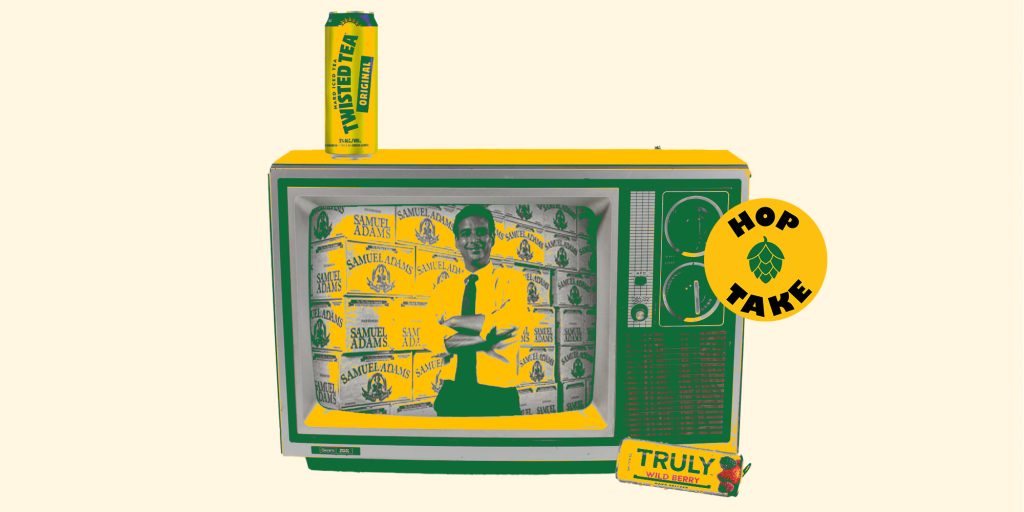
If you were among the tens of people still hoping to visit Truly Los Angeles taproom, you’d better do it soon. Parent company Boston Beer Co. (BBC) has a new chief executive readying to take the helm, and the odd, overbuilt hard seltzer outpost’s days are numbered.
“We unfortunately don’t see a clear path to growth or profitability for Truly LA in the future,” he wrote to the firm’s employees in an internal memo earlier this week obtained by Brewbound. The brick-and-mortar location will be “switching to Friday and Saturday service only by the end of the year”; once BBC’s lease expires on Truly’s Technicolor outpost in the Arts District, the jig is up.
That’s hardly surprising. Truly’s sales struggles have been going on for years, after all, and drinkers these days aren’t even visiting actual breweries as often as they used to, let alone flavored-malt-beverage approximations of breweries. The economic damage that the Trump administration’s shameful, pointless, and likely illegal occupation of Los Angeles this summer has been especially hard on the city’s food and beverage industries; that couldn’t have helped.
More surprising than the contents of the memo — which also signaled the closure of BBC’s Angel City Brewery at the end of its Arts District lease, while teasing a potential sale of the brand — was its author. Last week, The Wall Street Journal broke the news that Michael Spillane, the BBC board member and former Nike honcho who had served as CEO for just 16 months, would step down for “personal reasons” on Aug. 15. Filling the impending vacancy? That would be Jim Koch, BBC’s co-founder and longtime face of the country’s second-largest craft brewery, who himself exited the top job way back in 2001.
Meet the new boss, same as the old boss. For now.
“I don’t anticipate doing this in five years,” Koch told the WSJ. “There are multiple people who are not yet ready, but in a couple of years, one or two of them will be.” Citing scheduling conflicts, a spokesperson for BBC declined to make Koch available for an interview, instead referring me to the company’s official press release on the switch and his comments on the company’s earnings calls.
First-wave craft breweries like BBC face no shortage of challenges as the segment navigates its second “shakeout,” and I’ve argued before in this very column that succession is one of the biggest. The torch-passing options for the aging leaders of firms atop the Brewers Association’s Top 50 production list include selling to macrobrewers, mid-major foreign brewers, or private-equity firms (none of which are buying like they used to), or hiring a worthy successor.
This can be harder than you might think, even for craft brewing’s most storied players. To wit: Ken Grossman, the founder of Sierra Nevada Brewing Co., handed over the reins to the company’s second-ever CEO, Jeff White, in 2019, only to find himself taking them back half a decade later on an interim basis after White decided to retire midway through 2023 (capping off his own 38-year run in the business). Grossman and co. eventually found another man for the job, hiring former Suntory exec Pryce Greenow in early 2024.
But BBC is unique even among the old battleships that came up in the “microbrewing” era. For one thing, its portfolio is the most diverse of the bunch, and craft beer — Samuel Adams and Dogfish Head, acquired in 2019 — is a small and increasingly unimportant part of it. Companies like Sierra Nevada, D.G. Yuengling & Son, or even New Belgium are still oriented principally around selling beer-flavored beer (or at least Voodoo Ranger), whereas BBC is basically the inverse, depending heavily on flavored alcoholic beverages Twisted Tea and Truly for its present volume, and spirits-based ready-to-drink Sun Cruiser for its future outlook.
For another, it is alone among the craft segment’s heavyweights in its ownership structure. The company is publicly traded, but Koch has famously retained its controlling shares since floating it on the New York Stock Exchange in 1995. He chairs a board of directors that answers to… him, basically. There aren’t many billionaire chairmen who persist in doing press hits and earnings calls for the companies they represent, but Koch has remained a fixture in both for BBC, even as he’s pushed into his 70s.
Now 76, his return to the chief executive chair is unusual in the broader business world (average CEO ages in the S&P 500 and Russell 3000 hover around 60). But for better or worse, BBC has been Koch’s company since its public listing.
Still, it’s a company that’s virtually unrecognizable compared to the one he last oversaw as CEO a quarter-century ago. Sam Adams, once on the vanguard of the craft beer segment, has lost ground for years; its sales are down 7.5 percent in dollars and 8.8 percent in volume year-to-date through mid-June in multi-outlet grocery, mass retail, and convenience stores tracked by market research firm Circana. Angry Orchard has watched the cider category it helped to usher into the mainstream market pass it by, and endured some scorn along the way. Dogfish Head is showing life lately, delivering some growth to the balance sheet last quarter (though it’s still down in the off-premise year-to-date). But since acquiring the Delaware craft brewery in 2019 for $300 million — a setup, some hypothesized, for co-founder Sam Calagione to eventually succeed Koch — BBC has taken ~$85 million in impairment charges on its value.
Truly… man, what is there to say about Truly? The thing Koch himself says most often about it on earnings calls lately is: “not satisfied.” Why would he be? White Claw’s second fiddle soared during the pandemic, and BBC’s stock price with it. But the brand has since been hobbled by poor execution, a confusing parade of new releases, and rebrands and reformulations that haven’t stuck. Its off-premise dollars and volume were both down last quarter, ~16 and ~18 percent, respectively. Koch will have a growing hard seltzer (ish) to oversee in Hard Mtn. Dew, which is humming along after a rough rollout plagued by BBC’s distributors’ objections to PepsiCo’s now-defunct Blue Cloud scheme. But Truly is big enough, and doing badly enough, to be a drag on the entire company’s performance. To set up his next CEO hire for success, Koch will have to figure out a way to stabilize that brand — shuttering the taproom ain’t gonna cut it.
For now, Koch has two engines capable of powering BBC’s growth: Twisted Tea and Sun Cruiser. The former had been riding a rocket (pop) up the sales charts for half a decade before finally petering out a bit this past quarter thanks to a big denominator, bad weather, and increased competition. (It was down 3.6 percent in dollars and 5.6 percent in volume in NIQ-tracked off-premise channels year over year through July, per Brewbound.)
“I was really surprised when I’ve been out in the market to see how the retailers have swung towards RTD displays,” he told analysts on the Q2 earnings call in late July. “Gallo — who we never really thought we were competing for beer display space with — had big High Noon displays and big displays for their new vodka lemonade, Lucky One. So displays that last year went to Twisted Tea didn’t go there.”
It’s a brave new world out there. But Koch will have a weapon here, too. After getting ambushed by upstart competitor Surfside, the latter has been a legitimate success for BBC, posting more than 700 percent gains in both dollars and volume year over year in the NIQ-tracked off-premise. Those eye-popping figures are partly due to Sun Cruiser’s small footprint (it was only introduced last year), but it’s a real comer.
Whether Koch, who co-founded BBC in 1984, is up to playing ringmaster with this menagerie of malt- and spirits-based beverage-alcohol brands really depends on how he defines his own success. On one hand, nobody can really fire him, so he won’t operate under the same quarter-by-quarter performance expectations as other CEOs. But on the other, he’s always been an aggressive competitor, and this is his life’s work. I can’t imagine he expected to be issuing memos to shut down the Truly taproom and marveling at Gallo’s designs on the beer aisle at the ripe old age of 76 (or ever, for that matter). But it’s equally hard for me to imagine he’d maintain the status quo while recruiting a replacement. It may not be a victory lap for craft brewing’s elder statesman, but it could still become one.
🤯 Hop-ocalypse Now
Everything is relative. For example, the data are in on tax paid beer shipments for June 2025, and according to analysis from the Beer Institute, they’re up 0.3 percent year over year. To the untrained ear, a mere 30 basis points may not sound so hot. It isn’t when compared to, say, a decade ago, when the category’s growth was double that figure. But as the trade group’s chief economist Andrew Heritage noted in a statement to Brewbound, the slight increase marks the “strongest growth” on a monthly basis so far this year. And get this: Removals for Q2 “only” declined at about half the rate they did in Q1! Good news is just a matter of perspective, when you think about it.
📈 Ups…
Great American Beer Festival tickets are now on sale, sickos… Congrats to Greig DeBow on his new gig as the chief executive of Pabst Brewing Company… The American Cider Association reported “real progress” in its early efforts to raise $250,000 to expand its advocacy for the segment…
📉 …and downs
Molson Coors was in the red for Q2, posting -2.6 percent net sales globally and -2.8 percent in the Americas… The flavored malt beverage segment continues to lose ground to spirits-based RTDs, down 4 percent in the NIQ-tracked off-premise (more even than traditional beer!) year-to-date… The McCain dynasty’s Hensley Beverage announced plans to acquire the portion of Scout Distributing’s business in Arizona it didn’t already own…
The article Stop-Gap or Victory Lap? Jim Koch Is Back as Boston Beer’s CEO appeared first on VinePair.