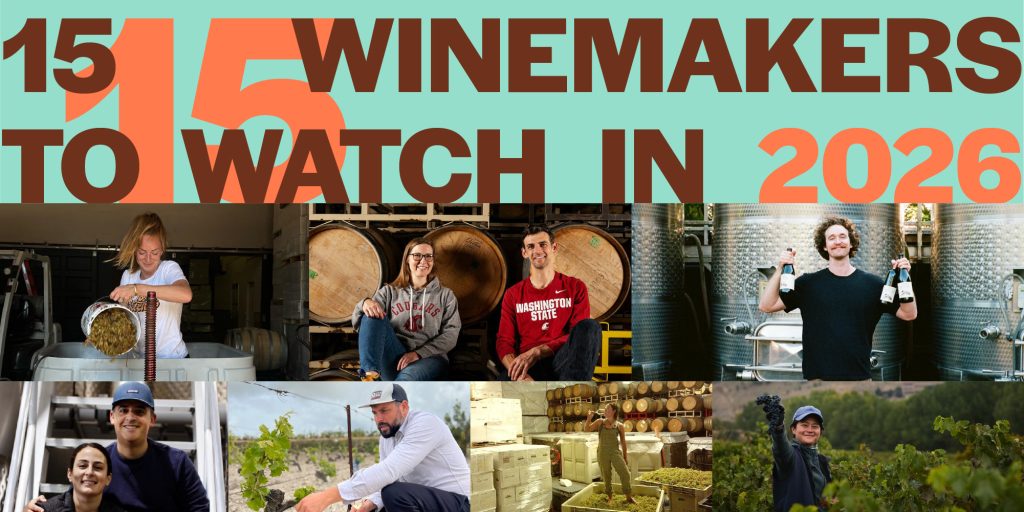
The wine industry at large is currently hovering in limbo — not yet reaching rock bottom, but also not quite sure how to find a way forward. But while execs discuss rebrands and business strategy, passionate winemakers are still finding ways to kickstart their dreams with projects that keep the heart of wine alive.
This list showcases the next generation of producers intent on making their mark on the world of wine. Some are working with unexpected varieties (anyone for a California-grown Treixadura?) while others are experimenting with new styles that shake up the norms of the region. Fresh expressions of Tempranillo from Rioja, unfortified Palomino from Andalucia, and bright Vermentino from California’s Central Coast all serve to remind us that there are still plenty of fun, exciting things happening in wine, and at a time wine needs it most.
Read on to discover 15 winemakers you should keep an eye on in 2026.
Arabilis Wines — Willamette Valley, Ore.
Credit: Arabilis Wines via Instagram
While the Willamette Valley is full of interesting Pinot-focused upstarts, Arabilis is part of an exciting movement in the region focusing on traditional-method sparkling wines. Husband-and-wife team Kenny and Allison McMahon launched the brand in 2021 with 300 cases of wine from the 2018, 2019, and 2020 vintages. The full-fledged winery now produces 2,200 cases — 95 percent of which are traditional-method sparkling wines. (Though we do also love their Pinot Noir, which appeared on VinePair’s 50 Best Wines of 2025.)
Agrícola Calcárea — Andalucia, Spain
Credit: Agrícola Calcárea via Instagram
Something exciting is happening in Andalucia. While the historic region in southern Spain has long been known for producing sherry wines, a new wave of producers in the area are leaning into unfortified expressions of local grapes like Palomino. One of the newest names on the scene is Juan Jurado, who launched Agrícola Calcárea in 2022 using all of his savings to buy a small vineyard in the well-regarded Miraflores de Sanlúcar area. His lineup of wines showcases the distinct grape varieties and soil types of the area including a dry Moscatel from 45-year-old vineyards and a fresh, mineral-driven Palomino fermented in manzanilla casks.
BXT Wines — Napa Valley, Calif.
Credit: BXT Wines via Instagram
Founded in 2018 by winemaker Tom Sherwood, BXT explores the intricacies of California viticulture through traditional-method sparkling wines. Like a few of California’s most sought-after sparklers, BXT applies the grower-producer approach, influenced by the small-production farmers in Champagne. In that vein, Sherwood organically farms grapes in Napa and Sonoma and sources organically grown fruit from unique sites and people all up and down California, from the Petaluma Gap and Russian River Valley to San Benito and the Santa Cruz Mountains. Many of the wines are single-vineyard or single-varietal, honing in on a particular region’s terroir. The wines are aged in French oak barrels and some cuvées even use solera aging to add complexity. BXT currently produces about 900 cases a year. Though Sherwood plans to grow the project — he recently moved the operation to a new space — the production volume will likely stay small, considering each wine is hand-bottled, riddled, and disgorged.
Cascina Lieto — Piedmont, Italy
Credit: @liquid_okinawa on Instagram
Hiroto Sasaki moved from Japan to Rome in 1997 and immersed himself in the world of Italian wine. Inspired by great natural winemakers from the north like Dario Prinčič, Hiroto and his wife Rie decided to establish a winemaking venture of their own. The pair found a 2.5-acre plot in the small Castiglione Tinella area of Piedmont, a region typically known for its Moscato, and started Cascina Lieto, releasing its first vintage in 2018. They work with 60-year-old Moscato and Cortese vines and source grapes like Freisa and Barbera for the reds. The unique low-intervention wines showcase a different side of Piedmont, with their flagship a deeply tannic and aromatic skin-contact take on Moscato.
Damien Guadagnolo — Jura, France
Credit: Damien Guadagnolo via Instagram
France’s alpine Jura region gained much acclaim in the natural wine world for its high concentration of scrappy, terroir-focused winemakers producing wildly energetic bottles in tiny quantities. Though many of those small producers are now big names with cult followings, there’s still new life coming into the region. Damien Guadagnolo is a great example of this fresh generation of Jura producers, starting his own label in 2019 after working with the esteemed Jean-François Ganevat for seven years. Today, Guadagnolo biodynamically farms about seven acres of vines in the quiet village of Orbagna in the southern part of Jura. Guadagnolo makes site-driven expressions of Chardonnay, Savagnin, Trousseau, Poulsard, and Pinot Noir and in typical Jura fashion, each cuvée is available in extremely limited quantities.
Dominik Held — Rheinhessen, Germany
Credit: @weinskandal on Instagram
Dominik Held’s family history in Germany’s Rheinhessen dates back to 1604, but it wasn’t until 2020 that the young winemaker started his own project. One of the many up-and-coming producers in this region, he started with 3.5 acres of land and now farms about 12 acres of his family estate, working with grapes like Weissburgunder, Chardonnay, Riesling, Silvaner, and Scheurebe. White wines are Held’s primary focus, with wonderfully fresh, aromatic takes on these classic varieties. For fans of bright, mineral-driven white wines that still show ample complexity, definitely keep an eye on the wines from Dominik Held.
Farm Cottage Wines — Santa Cruz Mountains, Calif.
Credit: Farm Cottage Wines via Instagram
Ryan Alfaro started Farm Cottage Wines by happenstance. Growing up surrounded by the industry — his parents started their own project, Alfaro Family Vineyards, in 1997 — Alfaro had always been interested in wine (though as a child he may have resented some days of laboring in the vineyards). This interest prompted Alfaro to start working in winemaking in 2016 and go on to attend the University of Auckland for a post-grad in viticulture and enology. In 2019 he was helping out at his parents’ estate when he came across the opportunity to work with Pinot Noir from Santa Cruz’s esteemed Trout Gulch Vineyard and leaped at the chance to craft his dream cool-climate, whole-cluster Pinot. Now, Farm Cottage has a lineup of several site-specific Pinots as well as Chardonnay, Syrah, and Cabernet Sauvignon all from the western side of the Santa Cruz Mountains — an area Alfaro is drawn to for its bright fruit and refreshing acidity.
Fioritura Wines — Central Coast, Calif.
Credit: Fioritura Wines via Instagram
It’s no secret we’re a fan of the cool, coastal wines of California’s Central Coast, and Fioritura Wines is a new label coming out of one of our favorite wineries in the area. Founder Gianna Prainito has worked with Mikey and Gina Giugni at the beloved Scar of the Sea and Lady of the Sunshine wineries since 2022, and after voicing her interest in making a new Italian-inspired project, Mikey insisted she start right away. Prainito first discovered her love of wine while trekking across Italy in 2019 — from the volcanic soils of Mt. Etna to the alpine slopes of Piedmont — eventually landing at a small farm and vineyard in Umbria. When it was time to make her own wines, this experience moved Prainito to seek out Italian varieties from organically and biodynamically farmed sites across the Central Coast. (Fioritura means “bloom” in Italian.) Her 2024 releases included Vermentino and Sangiovese, and she plans to launch a Nebbiolo in 2027.
Jade Gross — Rioja, Spain
Credit: @leonandsonwines on Instagram
On the surface, Jade Gross’s story seems pretty compelling: a Hong Kong-born Chinese-American making fresh, terroir-driven wines in Rioja. But that doesn’t even cover half of it. Gross started her career as a human rights lawyer after receiving her degree from the London School of Economics, but soon after shifted her focus to the culinary world, enrolling in a French cooking school with a grant from the James Beard Foundation. She spent time in several Michelin-starred restaurants and worked as an intern at Alain Ducasse au Plaza Athénée, eventually working her way up to the head chef position at Mugaritz in San Sebastian.
Even after stacking up the culinary accomplishments, Gross still wanted a new challenge, so in 2019 she moved to the small town of San Vicente de la Sonsierra and started a new project making wine. Amid a sea of heavily oak-aged wines in Rioja, Gross’s wines stand out with their vibrant, energetic profiles, including a bright, berry-forward take on Tempranillo. Her wines first hit the U.S. market in 2022 and continue to gain fans across the country.
Jorge Olivera — Pyrenees, Spain
Credit: @tuurlijkwijnen on Instagram
Tucked into the foothills of the Pyrenees, Jorge Olivera has been slowly building up his wine project since he planted his first Tempranillo vines in 2009. Olivera started out making wine as a hobby, producing his first vintage in 2011, crafting small quantities in a stainless steel tank that was only for family use. He constructed a small winery in 2021, and since then his production has grown significantly, prompting him to leave his job as a mechanical engineer in 2023 to focus on wine full time. He now makes a range of wines, including expressions of the well-known Tempranillo and more obscure local varieties like Moristel. Olivera’s wines are appreciated for their freshness and restraint. And they just arrived in the U.S. this year from importer T. Edward.
Novella — Monticello, Va.
Credit: Novella via Instagram
Novella is a new winemaking venture from veteran Washington, D.C., sommeliers Jen Anderson and Karl Kuhn. The two met while working in the tasting room of RdV (now Lost Mountain Vineyards) in Virginia. Driven by their insatiable curiosity and interest in wine, they decided to give winemaking a go. After working a few harvests in the region, they started their own label via Commonwealth Crush, a local incubator facility for small producers. The brand launched with 100 cases of a bright, mineral-driven Petit Manseng from the 2024 vintage. And in 2025 they started making a rosé of Cabernet Franc. Anderson and John hope to expand with a sparkling wine and a red cuvée in the coming years.
Orixe Sotelo — Sonoma, Calif.
Credit: Orixe Sotelo via Instagram
Founded by Gustavo and Jackie Sotelo in 2019, Orixe Sotelo focuses exclusively on Spanish grape varieties grown in California. Before starting the project, Gustavo accumulated years of winemaking experience across Napa and Sonoma, notably landing the job as head winemaker for Sonoma’s beloved Scribe Winery. The new project works with a wide range of Spanish varieties like Albariño, Godello, Treixadura, Arinto, Tempranillo, and Graciano from across northern California.
Ria’s Wines — Finger Lakes, N.Y.
Credit: Ria’s Wines via Instagram
In 2021 wife-and-husband duo Ria D’Aversa and Mike Penn moved to the Finger Lakes to start a new wine adventure. Between D’Aversa’s background in viticulture and organic farming and Penn’s time winemaking — plus their combined experience working in California, Italy, France, and New Zealand — the two felt it was time to make their mark somewhere new. They landed on a site just 1,000 feet from the southeastern shore of Seneca Lake on glacial soils and launched Ria’s Wines in 2022. They make a range of cool-climate wines ranging from classics like Riesling and Cabernet Franc to Baco Noir and Vignoles.
Vagabond Wines — Finger Lakes, N.Y.
Credit: Vagabond Wines via Instagram
Vagabond Wines is a self-described “micro-winery” coming out of the Finger Lakes. Partners Alex and Jimmer Bond started the project in 2022 with the goal of capturing the sense of wonder and adventure the vast Finger Lakes region has to offer. The two both work in nearby wineries while growing Vagabond on the side, but watch out for their Riesling, Blaufränkisch, and fizzy, low-ABV red sparkling called Farmer Fizz — with Chardonnay and Cab Franc to follow in upcoming releases.
Yarrow Wine Co. — Sonoma, Calif.
Credit: Yarrow Wine Co. via Instagram
Founder and winemaker Amanda McKenna has been dreaming of starting her own small-batch wine project since working her first harvest at Château de Béru in Chablis in 2018. Her first connection to wine came from working in restaurants, but being in the vineyards and the winery confirmed that she wanted to be a winemaker. In 2021 McKenna moved from Los Angeles to Sonoma County to work with Ryan and Megan Glaab at Ryme Cellars and started working on her own label under their guidance. For the Yarrow Wine Co. wines, McKenna sources grapes from thoughtfully farmed sites and focuses on early picking to maintain freshness. Yarrow’s first release just dropped with 250 cases, including the 2023 Albariño, 2024 Sauvignon Blanc, and 2024 Skin-Fermented Riesling — with Nero d’Avola currently aging in barrel to be enjoyed in the future.
The article 15 Winemakers to Watch in 2026 appeared first on VinePair.